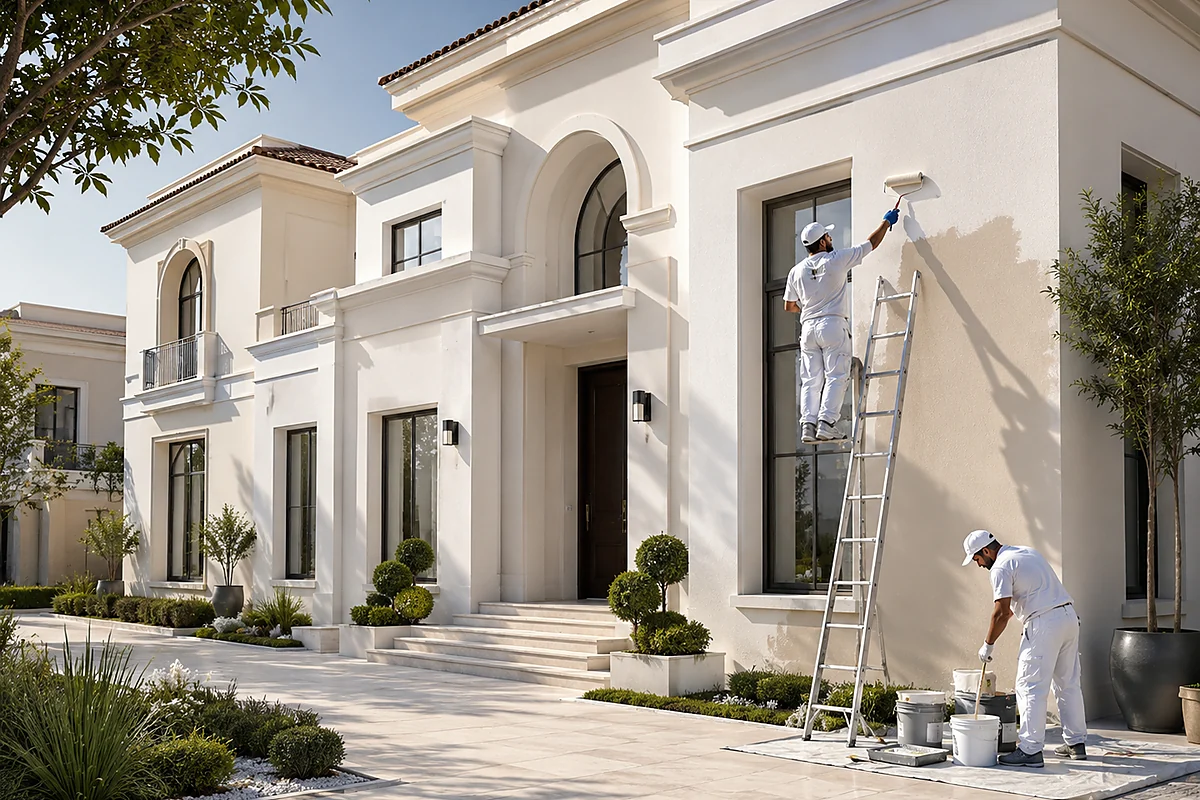
Exterior Painting in Dubai That Stands Up to Sun, Sand and Heat
Outside walls in Dubai take more punishment than almost anywhere else. Intense sun, blowing sand, humid nights and surface temperatures that soar in summer. Paint that survives that needs proper preparation, the right coating and careful timing.
In short: Best Fix Prime provides exterior painting in Dubai for facades, render, parapets, boundary walls, soffits, gates, railings and outdoor wood. We wash surfaces, repair cracks and damaged render, prime chalky and bare areas, treat rust and apply exterior paints or textured coatings suited to strong sun and heat. Work is timed to suit surface temperatures, especially in summer. Call or WhatsApp +971 50 108 4133.
Exterior painting in Dubai is less about colour and more about protection. A good exterior coating keeps moisture out of the render, reflects heat, resists fading and stops cracks from growing. When it fails, the signs are easy to spot: walls that leave a chalky powder on your hand, faded and patchy colour on sunny elevations, hairline cracks across the render, flaking paint at the base of walls and rust streaks below railings. This page explains why exterior paint fails in Dubai, how we prepare and coat outside surfaces, and how to choose the right finish.
Why does exterior paint fail so quickly in Dubai?
| Problem | What causes it | What fixes it |
|---|---|---|
| Fading and colour loss | UV radiation breaking down pigments and binders | UV-resistant exterior paint, lighter colours |
| Chalking (powder on the surface) | Weathered binder releasing pigment | Washing, sealing primer, new topcoat |
| Hairline cracking | Daily heating and cooling, render movement | Crack filling, flexible or elastomeric coating |
| Flaking at the base of walls | Irrigation water, rising damp, salts | Scraping, salt treatment, sealing, redirecting water |
| Blistering | Paint applied to hot or damp surfaces | Scraping, correct timing, repainting |
| Rust streaks | Corroding railings, grilles and fixings | Rust treatment, metal primer, sealing fixings |
| Dirty, dull appearance | Sand and dust embedded in the surface | Washing, smoother or dirt-resistant finish |
What is chalking and why does it matter?
If you rub your hand on an outside wall and it comes away with white or coloured powder, the paint is chalking. Sunlight has broken down the binder that holds the pigment together, and the surface is turning to dust. New paint applied straight over a chalky surface will not stick properly and can peel within months. Chalky walls are washed thoroughly and sealed with a stabilising primer that binds the loose surface before the new topcoats are applied.
How are exterior walls prepared?
Inspect the exterior
Render, cracks, hollow areas, chalking, flaking, rust, sealant joints and drainage are checked on every elevation.
Wash the surfaces
Dust, sand, salt deposits and loose material are washed off so the coating can bond to sound substrate.
Repair the render
Cracks are opened and filled, hollow or broken render is cut out and patched, and joints are resealed.
Prime
Repairs, bare render and chalky surfaces are primed or sealed; metal is treated with a rust-inhibiting primer.
Apply the finish
Two coats of exterior paint, or a textured or elastomeric coating, are applied at suitable surface temperatures.
Detail and inspect
Window surrounds, soffits, railings and gates are finished, masking is removed and every elevation is checked.
Washing is the step most often skipped, and it matters a great deal in Dubai. A wall that looks clean from a distance can carry a fine layer of sand and dust that stops paint from bonding. Washing removes it, along with salt deposits that can push paint off from behind.
How is cracked or damaged render repaired?
Render is the cement-based coat on most villa and building walls. Hairline cracks are common and are filled with a suitable exterior filler after being opened slightly so the filler grips. Wider cracks are filled and often bridged with reinforcing mesh. Tapping the wall reveals hollow areas where render has separated from the block behind it. These are cut out and patched, because they will eventually crack and fall away. Repaired areas are allowed to cure before priming so the new coating does not blister.
Which exterior coatings work best in Dubai?
There are several types of exterior finish, and the right one depends on the wall and the look you want. Smooth exterior emulsions give a clean, modern finish and are easy to repaint. Textured coatings add a raised finish that hides surface flaws and small cracks, and are common on Dubai villas. Elastomeric coatings are thicker and more flexible, stretching across hairline cracks as the wall moves, which makes them useful on walls prone to cracking. All should be rated for exterior use and strong UV exposure.
| Coating | Best for | Points to know |
|---|---|---|
| Smooth exterior emulsion | Modern facades, good render | Shows surface flaws; easy to recoat |
| Textured coating | Villas, uneven render, hiding repairs | Collects more dust; harder to change later |
| Elastomeric coating | Walls with recurring hairline cracks | Thicker, more flexible; needs proper application |
| Metal paint system | Gates, railings, grilles | Needs rust treatment and metal primer |
| Exterior wood finish | Doors, pergolas, shutters | Needs regular maintenance in strong sun |
When is the best time to paint outside?
Paint needs to dry at a steady rate to bond and form a durable film. In Dubai summer, wall surfaces in direct sun can become far hotter than the air temperature, and paint applied to them dries too fast, leading to poor adhesion, lap marks and blistering. The cooler months, roughly October to April, are the easiest time for exterior painting. In summer, we work early in the morning and follow the shade around the building, avoiding walls in direct midday sun. Painting is also paused during dust storms and if rain is expected. High humidity in the early morning can leave dew on walls, so surfaces are checked to make sure they are dry before the first coat goes on.
Which colours last longest outside?
Lighter colours last longest on Dubai exteriors. Whites, creams, sand and light stone shades reflect more heat, keep walls cooler and show fading less than strong or dark colours. Dark colours absorb heat, which increases movement in the wall and speeds up fading, and bright reds, blues and yellows tend to lose their intensity faster in strong sun. If you want a darker or stronger accent, use it on smaller areas such as doors, window frames or a feature panel.
How are gates, railings and grilles painted?
Exterior metal rusts quickly once the paint is chipped, and rust spreads under the surrounding paint. Loose rust and flaking paint are removed by wire brushing or sanding, the metal is degreased, and a rust-inhibiting primer is applied to bare and treated areas. Two coats of a durable metal finish follow. Rust streaks on walls below railings and fixings are cleaned and sealed so they do not bleed through the new wall paint.
What about parapets, copings and roof edges?
Parapets and the tops of walls are the most exposed parts of any building. They get the full sun all day and are where rainwater sits on the rare wet days. Cracks here let water into the wall below, causing stains and damage inside. These areas are inspected closely, cracks are sealed, and coatings are applied with extra care to the top surfaces and drip edges so water runs off rather than soaking in.
How is outdoor wood protected?
Wooden doors, pergolas, shutters and gates dry out, crack and grey in the Dubai sun. Wood is sanded back to sound timber, cracks and gaps are filled, and an exterior wood primer or stain is applied, followed by a finish suited to outdoor wood. Outdoor wood needs more frequent maintenance than masonry, and a light refresh every year or two prevents the need for heavy sanding later.
Why does paint flake at the bottom of walls?
Flaking and white powder at the base of walls is very common around villas and gardens. It is usually caused by water from sprinklers and irrigation soaking into the wall, carrying salts with it. As the water evaporates, the salts crystallise behind the paint and push it off. Repainting without dealing with the water simply repeats the problem. Sprinklers are adjusted or redirected, the affected area is scraped back, cleaned, treated and sealed, and the wall is repainted.
Can exterior painting reduce heat inside?
Light-coloured exterior paints reflect more sunlight, which can reduce the amount of heat absorbed by walls, particularly on west- and south-facing elevations. Some coatings are designed to reflect heat even more effectively. The effect varies with insulation and construction, so it is not a replacement for good AC, but a light, reflective exterior can help reduce surface temperatures and the heat load on the rooms behind those walls.
Do you paint small buildings and shopfronts?
Yes. Alongside villas, we paint the exteriors of low-rise buildings, warehouses, small offices and shopfronts. For businesses, exterior painting is often about brand and first impressions, so colours are matched to branding and work is scheduled to avoid disrupting customers. Work at height on taller elevations is planned with the right access equipment. For high-rise facades that need specialist rope access or building cradles, we will advise if the job is outside our scope.
How long does exterior paint last in Dubai?
With good preparation and quality exterior paint, a facade usually looks good for several years, though sun-facing walls fade sooner than shaded ones. Textured and elastomeric coatings can last longer on suitable walls. Washing the exterior once or twice a year to remove dust, and repairing small cracks before they grow, extends the life of the coating. Regular inspection is much cheaper than waiting for widespread failure.
How do you check an exterior before quoting?
A proper exterior inspection goes beyond looking at the colour. We walk every elevation, rub the surface to check for chalking, tap the render to find hollow areas, look closely at cracks to judge whether they are surface cracks or deeper movement, and check sealant around windows and joints. We look at the base of walls for salt and damp, the tops of parapets for cracks, and metalwork for rust. This tells us exactly how much preparation is needed, which is the biggest variable in any exterior painting quote.
What about sealant around windows and joints?
Windows, doors, expansion joints and junctions between different materials are usually sealed with a flexible sealant. In the Dubai sun, sealant hardens, shrinks and cracks over time, letting dust and water in. Old, failed sealant is cut out and replaced with a new exterior-grade sealant before painting, and where it is designed to be painted over, it is coated to match. This small step helps keep water and dust out of the building and gives a much neater finish around windows.
Can you change the colour of an exterior?
Yes, where building or community rules allow. Changing from a dark to a light colour usually needs a primer and two topcoats for full, even coverage. Changing from light to dark is easier in terms of coverage, but remember that darker colours fade faster and absorb more heat. Before committing, paint large sample areas on different elevations and look at them in full sun and shade. For villas in managed communities, confirm the new colour is approved before work starts.
How are soffits, ceilings and covered areas painted?
Covered outdoor areas such as car porch ceilings, balcony soffits, entrance canopies and covered terraces are sheltered from direct sun but collect dust, cobwebs and sometimes AC condensation. They are cleaned, repaired and painted with an exterior-grade paint suited to the conditions. Light fittings are masked or removed. Because these areas are seen from below, smooth coverage and clean edges matter just as much as on the main walls.
What about exterior stairs and outdoor walls by pools?
Walls around pools and outdoor stairways face splashing, chlorine and constant sun. Standard exterior paint can blister or fade quickly in these areas. Surfaces are cleaned of chlorine residue and salts, repaired and coated with a paint suitable for damp, exposed conditions. Painted floor surfaces and pool interiors need specialist coatings and are not part of a standard exterior painting job, so we will advise separately if they are needed.
How do you keep paint off windows, plants and paving?
Exterior painting involves a lot of masking and protection. Windows, glass, frames, door hardware and light fittings are masked. Plants and garden beds are covered with breathable sheets. Paving, decking and driveways are protected with drop sheets, and outdoor furniture is moved or covered. Cars are moved away from walls being painted where possible. At the end of each day, the site is tidied, and at the end of the job, all protection is removed and the area is cleaned.
Can exterior painting be phased?
Yes. If budget or time is limited, exterior painting in Dubai can be done in phases, starting with the elevations in the worst condition or the ones most visible from the street. Sun-facing walls often need attention first. Metalwork can be done separately from walls. Phasing works best when the same colour and coating are used throughout, so the finish matches when the whole exterior is complete.
How should you care for exterior paint between repaints?
- Wash walls gently once or twice a year to remove dust and sand
- Keep sprinklers pointed away from walls and gates
- Touch up chips on gates and railings before rust spreads
- Seal small cracks as soon as they appear
- Check parapets and wall tops after rare rainy days
- Keep leftover exterior paint, stored out of the sun, for touch-ups
A short annual check of the outside walls catches small problems while they are still cheap to fix and keeps the whole exterior looking cared for until the next full repaint.
Is it worth repainting before the paint has fully failed?
Usually, yes. Once paint has started to chalk and fade but before it is cracking and flaking, the wall can be washed, sealed and recoated with relatively little repair work. If it is left until the coating has failed widely, render is exposed, cracks grow and much more preparation is needed. Repainting at the right time is one of the simplest ways to keep exterior painting in Dubai affordable over the long term.
Why choose Best Fix Prime for exterior work?
We do the unglamorous parts properly: washing, render repair, chalk sealing and rust treatment. We time the work for surface temperatures, protect gardens, pools and paving, and finish every elevation to the same standard. Exterior painting in Dubai with us comes with a written quote that sets out the preparation, coating type and number of coats for each area.
The cost depends on the wall area, height and access, the condition of the render, the amount of crack and render repair, the coating type, the number of colours and how much metalwork and wood is included. Smooth paint on sound render costs less than a textured or elastomeric coating over walls needing repair. We inspect every elevation and give you a written quote broken down by area.
Painting services for inside and out
Book an exterior inspection
Send us photos of the outside walls, gates and railings and tell us your property type and location. Call or WhatsApp +971 50 108 4133, or use the form at the top of the page. Photos of each side of the building, close-ups of any cracks, flaking or rust, and a note of any community colour rules help us give you an accurate first estimate. We then visit to inspect the walls in person, confirm the preparation needed and give you a written quote broken down by elevation, with a schedule that suits the season.
Best Fix Prime (Bestfix Prime Technical Services LLC)
AddressRoom 201, 3rd Avenue by Ya Building, Street 27, Mirdif, Dubai, United Arab Emirates
Call and WhatsApp+971 50 108 4133
Emailinfo@bestfixprime.ae
HoursOpen 24 hours, 7 days a week
Frequently asked questions
What does exterior painting in Dubai include?
Exterior painting in Dubai with us includes washing, crack and render repair, priming, rust treatment and coating of facades, walls, gates, railings and outdoor wood.
Why is my outside paint chalky?
Sunlight has broken down the paint binder. The wall needs washing and a sealing primer before repainting.
Why does exterior paint fade so fast here?
Strong UV light breaks down pigments and binders. Lighter colours and UV-resistant paints fade less.
Can you paint outside walls in summer?
Yes, early in the day and in the shade, avoiding walls in direct midday sun.
What is elastomeric paint?
A thick, flexible exterior coating that stretches across hairline cracks as the wall moves.
Should I choose a textured or smooth finish?
Textured hides flaws and repairs; smooth looks modern and is easier to repaint.
How do you fix cracked render?
Cracks are opened and filled; hollow render is cut out and patched before priming.
Why is paint flaking at the base of my walls?
Usually irrigation water carrying salts. The water source must be redirected before repainting.
Do you wash walls before painting?
Yes. Dust and sand stop paint from bonding properly.
Which exterior colours last longest?
Light colours such as whites, creams and sand shades.
Do you paint metal gates and railings?
Yes, with rust removal, rust-inhibiting primer and durable metal paint.
Can you remove rust streaks from walls?
Yes. They are cleaned and sealed so they do not bleed through.
Do you paint wooden pergolas and doors?
Yes, with sanding, an exterior wood primer and a suitable finish.
Can light exterior paint reduce heat?
It can reduce heat absorbed by walls, especially on sun-facing sides.
Do you paint shopfronts?
Yes, with colours matched to branding and work timed around customers.
Do you paint high-rise facades?
We handle low-rise buildings. For work needing rope access or cradles, we will advise.
How long does exterior paint last?
Usually several years, depending on exposure, preparation and the coating.
Do you protect plants and pools?
Yes. Gardens, pools, paving and outdoor furniture are covered.
What happens if it rains during painting?
Work pauses if rain is expected, and affected areas are recoated once dry.
How do I book an exterior inspection?
Call or WhatsApp +971 50 108 4133 with photos of the walls.