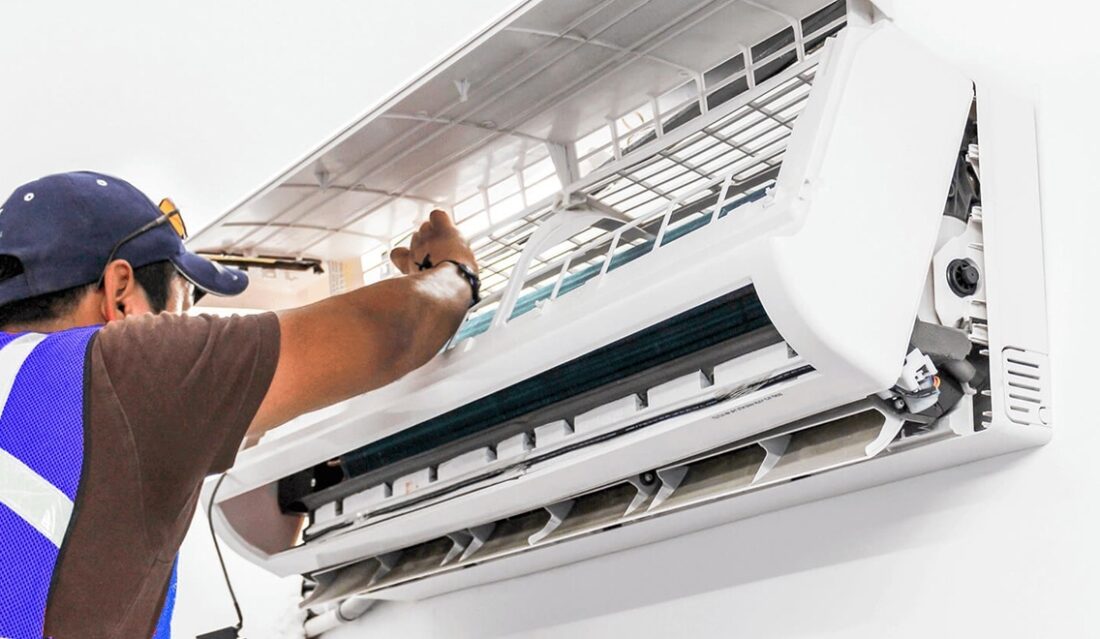
AC Repair in Dubai With a Proper Diagnosis First
From a unit that will not start to one that blows warm air, leaks or trips the power, we find the real fault and fix it properly.
In short: Best Fix Prime provides AC repair in Dubai for split, ducted, central, cassette and window units. Our technicians measure pressures, voltages and temperatures to find the actual fault, then repair or replace parts such as capacitors, fan motors, compressors, control boards, sensors and leaking pipework. We cover all of Dubai and take repair calls 24/7 on +971 50 108 4133.
When an air conditioner fails in Dubai, the pressure is on to get it working again fast. That is exactly when corners get cut: gas gets topped up without anyone looking for the leak, a part gets swapped because it is the usual suspect, and the same fault returns a few weeks later. Good AC repair in Dubai starts with slowing down just enough to find out what has actually gone wrong.
This page is about the repair side of our air conditioning work. It covers the problems we fix, how our technicians diagnose them, the parts we repair and replace, why some faults keep coming back and what you can do to stay comfortable while you wait. For routine servicing and the wider picture, see our main AC servicing and repair page.
What problems does our AC repair service cover?
Most calls start with a symptom. Here is what each one commonly points to, and how our technicians confirm it on site:
| What you notice | Possible causes | How we confirm |
|---|---|---|
| Unit will not switch on | Tripped breaker, failed control board, blown fuse, faulty remote | Voltage checks at the isolator and board, remote test |
| Outdoor unit hums but does not run | Failed capacitor, seized fan motor, compressor start problem | Capacitor test, motor resistance check, current draw |
| Air blows but is not cold | Low refrigerant, dirty coil, compressor not running | Pressure readings and temperature split across the coil |
| Cools for a while, then stops | Overheating compressor, faulty sensor, blocked condenser | Running pressures, sensor resistance, outdoor airflow check |
| Trips the breaker | Short in the compressor or fan, damaged wiring, failing contactor | Insulation and continuity tests, wiring inspection |
| Flashing light or error code | Sensor, communication or fan fault flagged by the unit | Reading the code and testing the related component |
| Grinding or squealing noise | Worn fan bearings, loose blower wheel, debris in the fan | Visual and manual check with the power isolated |
Weak cooling and out-of-hours breakdowns have dedicated pages of their own, linked at the bottom of this page.
What tools do our technicians use to diagnose faults?
A reliable diagnosis rests on readings, not opinion. Our technicians carry the equipment needed to test an AC system properly:
- Manifold gauges to read refrigerant pressures on both sides of the system
- A clamp meter to measure the current drawn by the compressor and fans
- A multimeter to test voltages, capacitors, sensors and wiring continuity
- Temperature probes to measure air entering and leaving the coil
- An electronic leak detector to trace refrigerant escaping from joints and coils
- Nitrogen for pressure testing repaired pipework before it is refilled
- A vacuum pump to remove air and moisture from the system after any repair that opens it up
Those readings are compared with what the unit should be doing. The gap between the two is where the fault is.
Which AC parts do we repair or replace?
Depending on what the diagnosis shows, an AC repair can involve any of these components:
- Capacitors, which help the compressor and fan motors start and run
- Contactors and relays, the switches that send power to the compressor
- Indoor blower motors and outdoor condenser fan motors
- Compressors, the heart of the cooling system
- Control boards and display panels
- Room and coil temperature sensors
- Expansion valves that regulate refrigerant flow
- Condensate pumps on cassette and ducted units
- Louvre and swing motors that direct the airflow
- Copper pipework, flare joints and service valves
Replacement parts are matched to the unit, so the repaired system runs the way it was designed to.
Can most AC repairs be finished in one visit?
Many can. Capacitors, contactors, sensors, blocked drains, loose wiring and small leaks at accessible joints are often fixed on the first visit, because technicians carry the common parts. A short video when you book helps us bring what is likely to be needed.
Some repairs take longer. Compressors, control boards and fan motors for less common models may need ordering, and a leak hidden inside a coil can take more time to find and fix. When that happens, the technician explains the timing, makes the unit safe, and where possible gets it running in a limited way until the part arrives.
What makes an AC repair last?
The difference between a repair that holds and one that fails again is usually in the details nobody sees. On every repair, we stick to these standards:
Fix the cause
If a capacitor failed because the outdoor coil was choked with dust, the coil gets cleaned too.
Leaks before gas
Refrigerant is only added once the leak has been found and repaired.
Test the repair
Opened pipework is pressure tested with nitrogen and vacuumed before refilling, so moisture and air stay out.
Correct parts
Components are matched to the unit rather than forced to fit.
Sound connections
Electrical terminals are tightened and damaged wiring is replaced, not taped.
Prove it works
The unit runs under load while readings are taken again, and you see the result.
Why does the same AC fault keep coming back?
Repeat breakdowns almost always mean the underlying cause was never dealt with. The common patterns we see in Dubai:
- Capacitors that keep failing because the outdoor unit runs too hot from a dirty condenser or poor ventilation
- Gas that runs low every few months because the leak was topped up, not repaired
- Drains that block again because the pipe has lost its fall or the drain pan is full of sludge
- Compressors tripping because of low voltage or loose connections at the isolator
- Control boards failing after water from a blocked drain has dripped onto them
If your AC has had the same repair more than once, tell us when you book. Our technicians will look specifically for the root cause instead of repeating the last fix.
What does a compressor replacement involve?
The compressor is the most expensive single part in an air conditioner, so replacing one is never a quick decision. First, the technician confirms the compressor itself has failed and the problem is not a capacitor, contactor or wiring fault that only looks like a dead compressor. That step alone saves many customers a costly and unnecessary job.
If the compressor has genuinely failed, the refrigerant is recovered, the old compressor is cut out, and a matched replacement is fitted along with a new filter drier. The system is then pressure tested, vacuumed, recharged to the correct weight and run under load. On older units, we will talk through whether a compressor replacement is worth it compared with a new system before any work starts.
How do power supply and wiring affect AC reliability?
A surprising number of AC faults are electrical rather than mechanical. Loose terminals at the isolator heat up and cause voltage drop. Undersized or damaged cables starve the compressor of current at start-up. Isolators exposed to sun and rain on roofs corrode inside. Each of these makes motors work harder and run hotter, and eventually something gives.
During a repair, our technicians check the supply side as well as the unit, from the breaker in the distribution board to the isolator and the terminals inside the outdoor unit. Where wiring needs more work than a simple fix, our electrical team can take it on.
What should you expect when repairing an older AC?
Older units can still be repaired, but there are a few things to be aware of. Parts for discontinued models can take longer to source or may only be available as compatible alternatives. Some older systems use refrigerants that are being phased out, which affects the cost and practicality of gas repairs. And a fault on an older unit is more often the first of several.
None of that means an older AC should be written off. It means the repair conversation should include an honest look at the rest of the unit, so you can decide whether to repair now and plan a replacement later, or replace now and stop spending on the old system.
Which AC repairs should you never attempt yourself?
Cleaning a filter is fine. Most other repairs are not DIY jobs, for good reasons:
- Capacitors can hold a dangerous electrical charge even when the power is off
- Refrigerant is under pressure and needs proper equipment to recover and recharge
- Opening the refrigerant circuit lets in air and moisture that damage the compressor
- Wiring inside the unit carries mains voltage
- Outdoor units on roofs, balconies and high walls are a fall risk
If you have already tried something, tell the technician what was done. It helps the diagnosis and is far better than having it discovered halfway through the repair.
What questions should you ask an AC repair technician?
Whoever you use, these questions help you judge whether the repair is being done properly:
- What exactly has failed, and what caused it?
- Can you show me the readings or the faulty part?
- If the gas is low, where is the leak and will it be repaired?
- Is the replacement part matched to my unit?
- What is the full price, and will you ask before adding anything?
- Is there anything else on the unit I should keep an eye on?
Our technicians expect these questions and are happy to answer them.
How can you stay cool while waiting for a repair?
If the AC fails in summer and the technician is on the way, a few simple steps make the wait easier. Close curtains and blinds on sun-facing windows. Shut doors to rooms you are not using and keep everyone in the coolest room, ideally one with a working unit. Use fans to keep air moving, avoid cooking with the oven, and drink plenty of water.
If there are young children, elderly relatives or anyone unwell in the home, tell us when you call. We prioritise total cooling failures where heat is a health risk.
Does AC repair differ for villas, apartments and businesses?
The faults are similar, but the setting changes the job. In apartments, outdoor units are often on balconies, roofs or plant decks shared with neighbours, so access is arranged with the building. Villas typically have several units, ducted systems in ceiling voids and outdoor units on roofs or side passages. In shops, offices and restaurants, the priority is keeping the business trading, so repairs are scheduled to avoid peak hours and temporary cooling solutions are considered for longer jobs.
Whatever the setting, tell us about access before the visit: parking, building permits, the location of the outdoor unit and whether a ladder or roof key is needed. Sorting those details in advance means the technician spends the visit repairing your AC, not waiting at reception.
Is every AC breakdown an emergency?
Not always. A total cooling failure in a home during summer, especially with vulnerable people in it, is treated as urgent and goes to our emergency team. So is any AC fault that comes with a burning smell, sparking or water pouring onto electrics. A single unit in a spare room that has started cooling weakly, or a noise that has crept in over a few weeks, can usually be booked as a normal repair at a time that suits you.
If you are not sure which it is, call and describe it. We will tell you honestly whether it needs someone tonight or can wait for a planned visit, which is usually the more economical option.
How do we report back after a repair?
Once the job is done, you receive a short summary on WhatsApp. It covers what fault was found and what caused it, which parts were repaired or replaced, the readings taken before and after, and anything else on the unit worth watching. Photos of the faulty part or the work area are included where they help.
That record is useful later. It helps the next technician who works on the unit, gives landlords and tenants something clear to share, and makes it easy to spot a pattern if the same unit ever has another problem.
The price depends on what has failed. A capacitor or sensor replacement costs far less than a compressor or a hidden coil leak. Other factors include the unit type, how easy the indoor and outdoor units are to reach, whether a part needs ordering and whether the call-out is urgent. The technician diagnoses first and gives you the price before any repair begins, so you can decide with the full picture.
What should you do after an AC repair?
Run the unit normally and keep an eye on it for the first few days. Cold air, steady running and no water from the indoor unit are all good signs. If the repair was on a unit that had not been serviced in a while, book a full service soon after, because a fresh fault is often a sign that other parts are also due attention.
For units that matter to you, such as bedroom ACs or the system in your shop, putting them on a regular servicing schedule is the best way to avoid the next repair altogether.
More help with AC faults
Book an AC repair
Tell us the type of unit, what it is doing and when it started. A short video of the indoor and outdoor units running is ideal. WhatsApp or call +971 50 108 4133, or email info@bestfixprime.ae.
Best Fix Prime (Bestfix Prime Technical Services LLC)
AddressRoom 201, 3rd Avenue by Ya Building, Street 27, Mirdif, Dubai, United Arab Emirates
Call and WhatsApp+971 50 108 4133
Emailinfo@bestfixprime.ae
HoursOpen 24 hours, 7 days a week
Frequently asked questions
How quickly can you come for an AC repair in Dubai?
We give you an arrival time when you call, based on your location and our nearest technician. Total cooling failures in hot weather are prioritised over routine visits.
Do you charge for diagnosis if I decide not to go ahead?
Ask when you book and we will explain how the visit and diagnosis are charged for your job. You always know the repair price before any work starts.
What is the most common AC fault in Dubai?
Failed capacitors, blocked drains, refrigerant leaks and dirty coils are among the faults we see most often, largely because of the heat, dust and long running hours.
Why has my AC stopped working after a power cut?
Power cuts and surges can trip breakers, blow fuses or damage control boards and capacitors. Check the breaker and isolator first; if it still will not start, a technician should test the electrics.
Can a blown capacitor damage my compressor?
Yes. A weak or failed capacitor makes the compressor struggle to start, which overheats it. Replacing the capacitor early protects the compressor.
How do I know if my AC compressor has failed?
Signs include the outdoor unit humming without running, warm air from the vents and the breaker tripping when the AC starts. A technician needs to test the compressor to confirm.
Is it safe to keep using an AC that trips the breaker?
No. Repeated tripping indicates an electrical fault. Leave it off and book a repair so the cause can be found safely.
What does a flashing light on my AC mean?
Most units flash a light or show a code to signal a specific fault such as a sensor or fan problem. Tell us the pattern or code and the model when you book.
Can you repair an AC on the same day?
Often, yes. Many common faults are fixed on the first visit. Parts for less common models may need ordering.
Do you repair ducted and central AC as well as split units?
Yes. We repair split, ducted, central, cassette and window units in homes and commercial properties.
Will you tell me if my AC is not worth repairing?
Yes. If a repair does not make financial sense, for example a failed compressor on an old, corroded unit, we will say so and explain the replacement option.
Why does my AC make a clicking noise but not start?
Repeated clicking often comes from a relay or contactor trying to start the compressor, or a capacitor that is no longer strong enough. It needs testing by a technician.
Can low voltage damage my AC?
Yes. Low or unstable voltage makes motors and compressors draw more current and run hotter, which shortens their life. Loose connections at the isolator are a common cause.
What should I tell you when I book an AC repair?
The AC type, which unit is affected, what it is doing, when it started, any error code, and whether it has had the same fault before. A video helps.
Do you fix AC remote and display problems?
Yes. We check the remote, receiver, display and control board to find whether the problem is the control or the unit itself.
Can water damage my AC control board?
Yes. Water from a blocked drain can drip onto electronics and cause faults or permanent damage, which is why drain problems should be fixed quickly.
Do you repair AC units in commercial kitchens?
Yes. Kitchens are tough on AC because of heat and grease, and we schedule repairs around service times where possible.
What happens if a part needs to be ordered?
The technician explains the timing, makes the unit safe and, where possible, keeps it running in a limited way until the part arrives and is fitted.
How can I avoid AC repairs in future?
Regular servicing, clean filters, a clear outdoor unit and fixing small problems early prevent most breakdowns.
How do I book an AC repair in Dubai?
WhatsApp or call +971 50 108 4133 with your area, the unit type and what is happening. For AC repair in Dubai outside normal hours, the same number is answered 24/7.