Residential Water Tank Cleaning
Water tanks for homes of every size.
View service →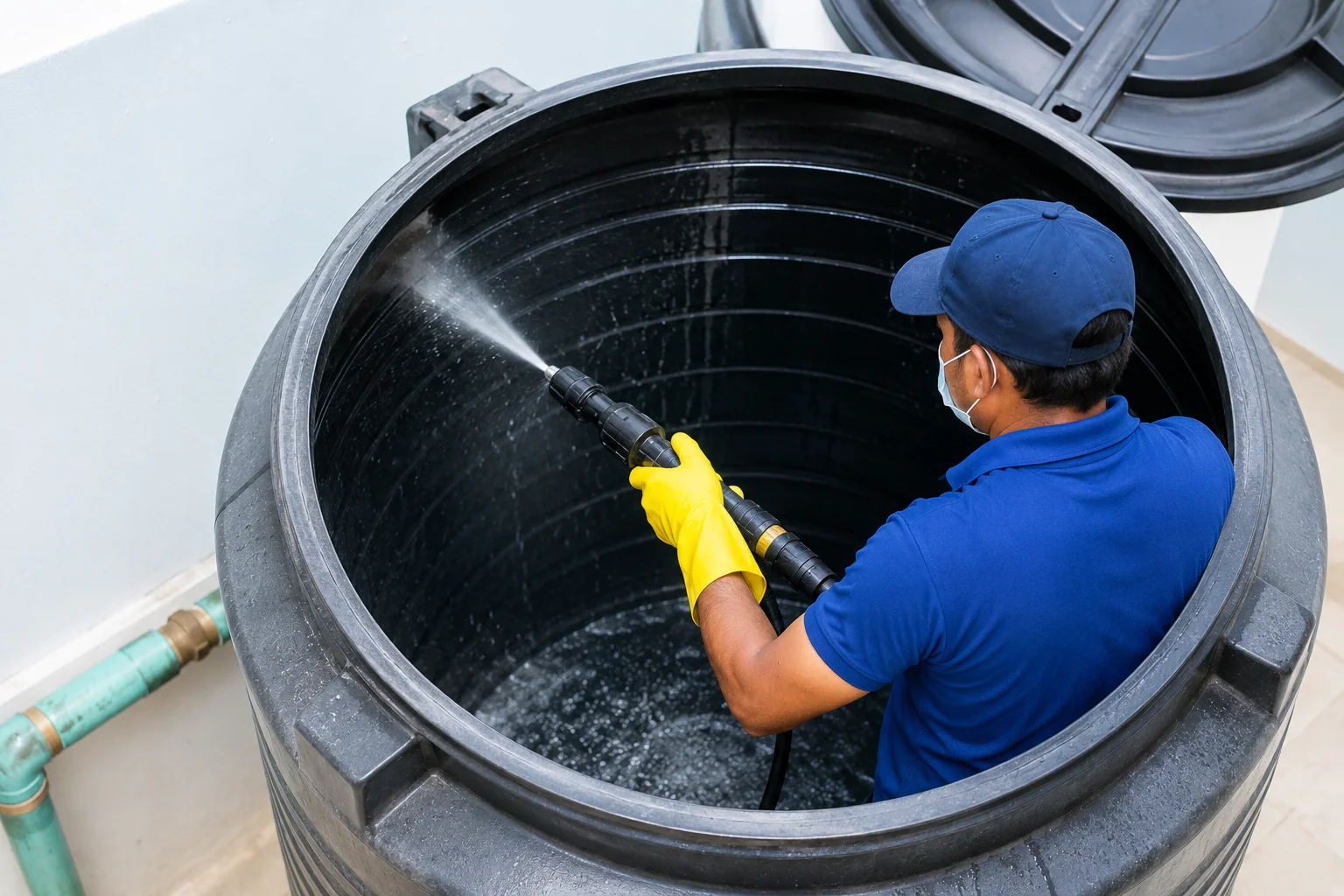
Most people never see the inside of the tank their water comes from. If they did, they would book a clean straight away. Sand, sludge, slime and sometimes insects collect in tanks over months. We drain them, clean them and disinfect them properly.
In short: Best Fix Prime provides water tank cleaning in Dubai for homes, villas and buildings. We clean overhead and underground tanks by draining them, removing sediment and sludge, scrubbing the internal walls and floor, disinfecting every surface, rinsing and refilling. You receive before-and-after photos and a note of any repairs needed. Most tanks benefit from cleaning at least once or twice a year. Call or WhatsApp +971 50 108 4133.
In many Dubai villas and buildings, water does not come straight from the mains to your tap. It is stored first, in a ground or underground tank and often again in a tank on the roof. Stored water sits still, and in Dubai it gets warm. Fine sand and silt in the supply settle to the bottom. A slippery film of bacteria, called biofilm, grows on the walls. Loose or damaged lids let in dust, insects and sometimes birds. Over time, this affects the water you use for showering, washing, cleaning and, in many homes, cooking. Regular water tank cleaning in Dubai keeps that stored water as clean as possible.
This page explains why tanks need cleaning, the signs that yours is overdue, how a professional clean works, how often it should be done and which service suits your tank. Each type of tank cleaning has its own page, linked below.
We clean tanks of every common type and size, from a single rooftop tank on a townhouse to the large underground tanks serving apartment towers. Choose the page that best fits your property or tank.
Water tanks for homes of every size.
View service →Overhead and ground tanks serving a single villa.
View service →Larger tanks serving residential and commercial buildings.
View service →Disinfection treatment after cleaning.
View service →Confined underground tanks cleaned safely.
View service →Rooftop and overhead tanks drained and cleaned.
View service →| Your situation | Best starting point |
|---|---|
| Home, apartment or townhouse with its own tank | Residential Water Tank Cleaning |
| Villa with a ground tank, roof tank and pump | Villa Water Tank Cleaning |
| Residential or commercial building with large tanks | Building Water Tank Cleaning |
| After contamination, repairs or a long period unused | Water Tank Disinfection |
| Ground or below-ground tank with manhole access | Underground Water Tank Cleaning |
| Rooftop or elevated tank | Overhead Water Tank Cleaning |
Three things happen inside every storage tank over time. First, sediment builds up. Fine sand, silt and rust particles carried in the supply settle on the tank floor, forming a layer of sludge that can be stirred up when the tank refills. Second, biofilm forms. Bacteria attach to the tank walls and create a slimy layer that protects them and allows them to multiply, especially in warm water. Third, contamination gets in. Gaps around lids, damaged vents, open overflows and cracks let in dust, insects, leaves and sometimes small animals.
None of these problems is visible from the tap until it is quite advanced. By the time water looks cloudy or smells odd, the tank usually needs more than a quick rinse. Regular cleaning stops the build-up from reaching that point.
If you notice several of these at once, or the water smells strongly, stop using it for drinking or cooking and book a cleaning and disinfection as soon as possible.
We check the tank type, size, access, lid, overflow, inlet and outlet, and look inside for sediment, slime, rust or cracks.
The time without stored water is agreed with you, and residents or staff are told in advance where needed.
The tank is isolated and drained, keeping only what is needed to flush sediment out at the end.
Settled sand, silt and sludge are removed from the floor of the tank.
Internal surfaces are scrubbed to remove biofilm, slime and scale, paying attention to corners and joints.
A suitable disinfectant is applied to all internal surfaces and left for the required contact time.
The tank is rinsed, flushed through, refilled and the lid and fittings are checked and secured.
You receive before-and-after photos and a short report noting any repairs the tank needs.
The exact method depends on the tank material, size and position, but the principle is the same: remove everything that has settled or grown inside, disinfect the surfaces and refill with fresh water. Skipping the scrubbing or disinfection stage, or simply draining and refilling, leaves the biofilm in place, and contamination returns quickly.
As a general guide, most residential tanks benefit from cleaning at least once or twice a year. Tanks that are exposed to high heat on roofs, older tanks, tanks with poor lids and tanks that serve many people may need more frequent cleaning. Many buildings and communities set their own schedules for shared tanks. If your water shows any of the warning signs above, do not wait for the next scheduled clean.
Dubai properties use several kinds of water tank. Glass-reinforced plastic (GRP) sectional tanks are common on villa roofs and in buildings. Polyethylene plastic tanks are found on many smaller properties. Concrete tanks are often built into the ground or the basement of buildings. Older properties may have steel tanks, which need extra attention for rust. Each material needs a slightly different cleaning approach: GRP and plastic are scrubbed gently to avoid scratching, concrete may need extra attention to cracks and joints, and steel needs checking for corrosion.
A typical villa roof tank can often be cleaned in a few hours. A villa with both a ground tank and a roof tank usually takes most of a day. Large building tanks take longer, and buildings with twin or compartmented tanks can often be cleaned one side at a time, so the supply is not interrupted completely. We agree the timing with you in advance so you can plan around the period without stored water.
For a few hours, usually yes, while the tank is empty and being cleaned. We recommend filling a few containers beforehand for essential use and avoiding laundry and dishwasher cycles during the clean. In villas, we can often plan the clean so the roof tank is cleaned while the ground tank still holds water, and vice versa, which reduces the time without supply. In buildings with two compartments, one side stays in service while the other is cleaned.
After disinfection, the tank is rinsed and refilled with fresh supply water. Once the refill is complete and the system has been flushed through by running taps for a few minutes, the water is generally fine for normal household use. Some people prefer to wait a little longer before using it for drinking, especially if a strong disinfectant was needed. We explain exactly what was used and any advice for the first day when we hand over.
Cleaning a tank is the best chance to inspect it, because it is empty and accessible. While cleaning, our team checks the lid and its seal, the vent and overflow screens, the inlet float valve, the outlet and any internal fittings, the condition of walls and joints and any signs of cracks, leaks or rust. Problems are photographed and noted in your report. Small issues such as a missing vent screen or a sticking float valve can often be fixed during the same visit, while larger repairs are quoted separately.
Many tank contamination problems start with a lid. Lids that are cracked, loose or missing a seal let in dust storms, insects, lizards and birds. Vent pipes and overflows without fine mesh screens do the same. Even a perfectly cleaned tank will become contaminated again quickly if the lid does not seal. Replacing a damaged lid or adding mesh screens is often the single most effective thing you can do to keep tank water clean between cleanings.
Yes. Because tank cleaning needs to happen on a schedule, it fits naturally into an annual maintenance contract alongside AC servicing and plumbing checks. Villa owners and building managers who include tank cleaning in a maintenance plan do not have to remember to book it, and the tank is always cleaned at the right interval. Records of every clean are kept for your reference, which is useful when selling, letting or handing over a property.
Indirectly, yes. Sludge and sediment from a dirty tank are drawn into the pipes when the tank is low, where they block tap aerators, shower heads, filters and the small passages inside mixers and water heaters. Cleaning the tank reduces the amount of sediment entering the system, which helps keep pressure steady and reduces wear on plumbing fittings. If your pressure is already poor, our plumbers can check the pump and pipework at the same time.
Heat is the biggest factor. Tanks on roofs and in direct sun can hold water that becomes very warm in summer, and warm, still water is ideal for bacteria and biofilm to grow. Dust storms carry fine sand that finds its way through any gap around lids and vents. Humidity causes condensation inside tank lids, which drips back into the water carrying whatever has settled on the underside of the lid. Water use also changes through the year, and tanks in homes left empty over summer can sit stagnant for weeks. All of this means water tank cleaning in Dubai needs to happen more regularly than in cooler climates.
It depends on the property. In a villa, the owner is usually responsible, though tenancy contracts sometimes assign routine maintenance to the tenant. In apartment buildings, shared tanks are normally the responsibility of the building owner or management, and residents cannot arrange cleaning themselves. In offices and commercial buildings, it usually falls to the landlord or facilities manager. If you are a tenant and unsure, check your contract or ask the landlord. If you are concerned about water quality in a building, raising it with building management is the right first step.
Sludge and dirty water removed from the tank are disposed of responsibly, usually to the drainage system in a controlled way, rather than being washed across gardens, paving or roofs where they leave stains. Where large amounts of sediment are removed, it is collected and taken away. The area around the tank is cleaned before we leave.
No. Filters on taps, showers or the main supply catch particles and can improve taste, but they do not stop sediment and biofilm building up inside the tank itself. In fact, a dirty tank makes filters clog much faster, so they need changing more often and may let more through once saturated. Filters work best alongside a clean tank, not instead of one. If you use a whole-home or under-sink filter, cleaning the tank regularly will help it last longer and work better.
Many Dubai residents travel for several weeks in summer. While the home is empty, water sits still in the tank and pipes and warms up in the heat, which is ideal for bacterial growth. When you return, run every tap and shower for a few minutes to flush the pipes. If the water looks cloudy or smells unusual, or the tank has not been cleaned for some time, book a clean and disinfection. Many families schedule tank cleaning just before they return, so fresh water is waiting for them.
Yes. Commercial premises such as offices, clinics, nurseries, restaurants and gyms often have their own tanks, and clean water matters even more where many people use it daily. We schedule cleaning outside opening hours where possible, so the supply interruption does not affect the business, and provide photos and a report for your records.
Yes. A newly installed tank, or one in a newly handed-over property, may contain construction dust, debris from installation and residues from manufacturing. Before a new tank is used for the first time, it should be cleaned, disinfected and flushed. If you have just moved into a new villa or building, it is worth asking when the tanks were last cleaned, or simply booking a clean before you start using the water.
We clean tanks properly, not just drain and refill them. Every surface is scrubbed and disinfected, every fitting is checked and every job comes with before-and-after photos and a short condition report. Because Best Fix Prime also provides plumbing services, we can repair float valves, pumps, lids and pipework found during the clean. We provide water tank cleaning in Dubai for villas, apartments and buildings across the whole city.
The cost depends on the number of tanks, their size and material, their position and access, how much sediment has built up and whether additional disinfection or repairs are needed. A single villa roof tank costs less than a large underground building tank. Send us the tank sizes or photos, and we will give you a clear price before booking.
Tell us your property type, how many tanks you have, their approximate sizes and where they are. Call or WhatsApp +971 50 108 4133, or use the form at the top of the page. If you do not know the size of your tanks, a photo of each tank and its label, if it has one, is usually enough for us to estimate. We will confirm the price and a date, tell you how long the water will be off and send a reminder before the visit, so you can plan around it with no surprises on the day.
AddressRoom 201, 3rd Avenue by Ya Building, Street 27, Mirdif, Dubai, United Arab Emirates
Call and WhatsApp+971 50 108 4133
Emailinfo@bestfixprime.ae
HoursOpen 24 hours, 7 days a week
Water tank cleaning in Dubai involves draining the tank, removing sediment and sludge, scrubbing all surfaces, disinfecting, rinsing and refilling.
Most residential tanks benefit from cleaning at least once or twice a year, more often for hot, old or heavily used tanks.
Cloudy or discoloured water, sand in the bath, unusual smells and filters clogging quickly.
A villa roof tank usually takes a few hours. Large building tanks take longer.
For a few hours while the tank is empty. We plan to keep this as short as possible.
Once the tank is refilled and the system flushed, it is generally fine for normal household use.
Yes, with safe working procedures for confined spaces.
Yes, including GRP, plastic and steel tanks.
Yes. Disinfection is part of every clean, not an optional extra.
Yes, before-and-after photos and a short condition report.
Yes. Lids, seals and vent screens can be repaired or replaced.
Sediment settles in the tank and is drawn into pipes when the level is low.
Often biofilm or stagnant water in the tank. Cleaning and disinfection usually solve it.
Yes, working with building management to minimise supply disruption.
Yes, alongside AC servicing and plumbing checks.
GRP, polyethylene, concrete and steel tanks.
Yes. Float valves, inlets, outlets and overflows are checked during the clean.
Yes. Sediment collects in heaters and reduces their efficiency.
Yes, for villas, apartments and buildings.
Call or WhatsApp +971 50 108 4133 or use the form on this page.
WhatsApp is opening
Press send in WhatsApp and our team will reply shortly. If it did not open, tap here.