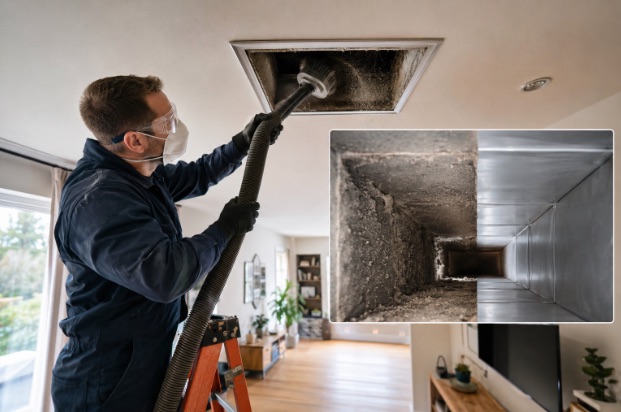
HVAC Duct Cleaning in Dubai for Larger Buildings and Systems
For buildings where the AC is a full HVAC system, with air handling units, fresh air units, risers and long duct networks, we clean the whole system, not just the grilles.
In short: HVAC duct cleaning covers the full air distribution system in larger buildings: air handling units, fresh air units, fan coil units, risers, main trunks, branches, dampers and terminal units. Best Fix Prime provides HVAC duct cleaning in Dubai by assessing the system, planning shutdowns with the facilities team, cleaning unit internals and ductwork section by section under negative pressure, and issuing a full report.
In a villa or apartment, duct cleaning usually means a few ducted units and their branches. In a commercial tower, school, hotel-style residence or large office, the AC is an HVAC system: air handling units in plant rooms, fresh air units on the roof, risers running between floors, and kilometres of ductwork feeding fan coils and diffusers. HVAC duct cleaning in Dubai at this scale is a planned engineering task, not a cleaning visit.
This page is for facilities managers, building engineers and MEP teams. It covers the components we clean, how shutdowns and access are planned, how different parts of the system are treated and what the final report includes.
What is included in an HVAC system?
| Component | What it does | Why it gets dirty |
|---|---|---|
| Air handling unit (AHU) | Filters, cools and moves air for a floor or zone | Handles large air volumes; coils and drain pans collect dust and slime |
| Fresh air handling unit (FAHU) | Brings in and conditions outside air | Draws in sand and dust directly from outside |
| Fan coil unit (FCU) | Cools individual rooms or zones from chilled water | Small filters, often neglected, near occupied spaces |
| Risers and main trunks | Carry air vertically and along floors | Long runs where dust settles over years |
| Branches and terminal units | Distribute air to rooms | Low air speeds let debris drop out |
| Dampers and attenuators | Control airflow and reduce noise | Collect dust; attenuators have delicate linings |
Why does HVAC cleaning start at the air handling units?
Because that is where dirt enters and where it grows. If an AHU has clogged coils, a slimy drain pan and dirty fan blades, cleaning the ducts downstream only buys a short reprieve, as the unit keeps sending debris into the clean ducts. We clean the units first, coils, drain pans, fan sections, plenums and filter housings, and replace filters, so the ductwork stays clean afterwards.
Why are fresh air units such a problem in Dubai?
Fresh air units pull outside air into the building, and outside air in Dubai often carries sand and fine dust, especially during shamal winds and sandstorms. Intake louvres and pre-filters load quickly, and if they are not maintained, dust passes into the unit and the fresh air ducts. Bird nesting near intakes is also common. Fresh air systems usually need more frequent attention than the recirculating parts of the system, and their intake screens should be checked after every major dust event.
How is the work planned?
System assessment
Air handling units, fresh air units, fan coils, risers and main duct routes are reviewed with the facilities team, using drawings where available.
Inspection
Representative sections of supply, return and fresh air ductwork, plus unit internals, are inspected and photographed.
Shutdown and access plan
Shutdown windows, isolation, access doors, lifting and permits to work are agreed for each part of the system.
Clean the air handling units
Coils, drain pans, fan sections, plenums and mixing boxes are cleaned, and filters are replaced.
Clean the ductwork
Main trunks, risers and branches are cleaned under negative pressure, section by section, with access doors fitted where needed.
Check dampers and components
Dampers, attenuators and terminal units are checked and cleaned with methods suited to each component.
Restart and report
The system is restarted and checked, and a full report with photos, defects and recommendations is issued.
How are shutdowns managed?
HVAC systems serve whole floors or buildings, so shutdowns must be planned carefully. We work with the facilities team to clean one AHU or zone at a time, typically at night or over weekends, keep temperature-sensitive areas running or on temporary cooling, and restart each system before occupants return. Shutdown windows are agreed in advance and confirmed each day, and if a window has to change at short notice, the plan is adjusted rather than rushed.
Do access doors need to be fitted?
Often. Many older buildings were built without enough access doors in their ductwork, which makes cleaning and inspection difficult. Where long runs cannot be reached from units or grilles, we fit proper hinged or removable access doors at suitable points. They are sealed and insulated, and they make every future inspection and clean easier.
How are dampers and attenuators treated?
Volume dampers are cleaned and checked to make sure they move freely and are set correctly. Fire and smoke dampers are life safety devices; we clean around them carefully, note their condition and report any that appear damaged or obstructed, but their testing and certification remain with the building's fire contractor. Sound attenuators often have fibrous linings that should not be brushed, so they are vacuumed gently or flagged for replacement if heavily contaminated.
What about internally lined ductwork?
Some HVAC ducts are lined inside with insulation or acoustic material. This lining cannot be scrubbed like bare metal. It is cleaned with soft methods under extraction, and if it is damaged, crumbling or contaminated with mould, the right answer is usually replacement of that section rather than cleaning. We identify lined sections during inspection and plan accordingly.
Which industry practices do we follow?
Our approach follows the principles widely used in the HVAC cleaning industry: inspect before cleaning, clean the whole system rather than isolated parts, use source removal with negative pressure, protect occupied areas, use methods suited to each material and verify the result visually with photos. Where a client requires work to a specific standard or specification, we review it during planning.
How does HVAC cleaning support indoor air quality?
In large buildings, the HVAC system is the lungs of the building, moving air for everyone inside. Dirty coils, drain pans and ducts can add dust, odours and microbial growth to that air. Regular cleaning, together with good filtration and maintenance, is a practical part of keeping indoor air quality acceptable for occupants. We do not make medical claims, but building owners increasingly see clean HVAC as part of their duty to occupants.
How often should building HVAC systems be cleaned?
Inspection is the best guide. As a starting point, AHU and FAHU internals usually need cleaning annually or more often, fresh air ducts every one to two years, and main supply and return ductwork every few years depending on filtration, occupancy and location. Buildings near construction, with heavy footfall or with known filtration problems need more frequent attention.
What does the final report include?
- Scope cleaned: units, risers, floors and zones
- Before and after photos at representative points
- Filters replaced and their grades
- Condition of coils, drain pans, dampers and linings
- Access doors installed and their locations
- Defects found, such as damaged ducts, missing insulation or drainage issues
- Recommendations and a suggested next inspection date
Which buildings typically need HVAC duct cleaning?
Office towers, schools and universities, mixed-use buildings, large retail units, residential towers with central systems, hotel-style serviced apartments, clinics and medical centres, and warehouses with central air handling. Any building where air is conditioned centrally and distributed through long duct networks benefits from system-level cleaning rather than piecemeal grille cleaning.
Why is HVAC duct cleaning in Dubai a building-wide job?
In a centrally conditioned building, every part of the system is connected. Dust from a neglected fresh air unit travels into every floor it serves. A slimy drain pan in one AHU can send odours through a whole zone. Cleaning a few grilles on one floor does little if the source is upstream. That is why HVAC duct cleaning in Dubai is best approached as a building-wide programme, even if the work itself is phased over weeks.
How are coils cleaned inside air handling units?
AHU cooling coils are deep and densely finned, and dust packs into them over time, reducing airflow and cooling. They are cleaned with coil-safe cleaning solutions applied from both faces where access allows, then rinsed carefully so debris flushes out into the drain pan rather than deeper into the coil. Fins are checked for damage and straightened where needed. A clean coil also makes the chilled water system work more efficiently.
Why do AHU drain pans matter so much?
The drain pan under an AHU coil collects condensation all day. If it does not drain fully, because it is poorly sloped, blocked or corroded, standing water forms a slimy layer where bacteria and mould thrive, right in the airstream. We clean the pan, clear the drain and trap, check the slope and report corrosion or leaks. Pans in poor condition are often the single biggest hygiene issue we find in plant rooms.
What about fan sections and plenums?
Fan wheels collect dust on their blades, which unbalances them, adds noise and reduces airflow. Plenums and mixing boxes, where return and fresh air meet, collect debris and sometimes hold moisture. Both are cleaned by hand and vacuum with the unit isolated, and the condition of each fan and its bearings is noted in the report.
How are risers cleaned between floors?
Vertical risers carry air between floors and are among the hardest parts of the system to reach. Access doors at each floor allow brushes and air tools to be worked up and down the riser while extraction pulls debris out. Planning is essential, as riser cleaning often affects several floors at once and needs coordination with every tenant those floors serve.
How do we work in plant rooms and on roofs?
Plant rooms are tight, noisy spaces with live equipment, and rooftop units bring heat and working-at-height risks. Our crews work under the building's permit-to-work system, isolate units properly, use safe access to rooftop equipment and avoid working on rooftops in the hottest part of the day in summer where possible. Safety arrangements are agreed in the method statement before work starts.
Can HVAC cleaning reveal hidden problems?
Frequently. Opening up a full HVAC system often reveals corroded drain pans, damaged coil fins, disconnected flexible ducts above ceilings, missing insulation, failed dampers and old construction debris. Everything is photographed and included in the report with a recommendation, so facilities teams can prioritise repairs with clear evidence rather than guesswork.
How is HVAC cleaning coordinated with tenants?
In multi-tenant buildings, cleaning one AHU can affect several tenants. We work with building management to notify affected tenants in advance, schedule work outside their hours, protect their spaces when we need access above their ceilings and keep them informed when their area is finished. Clear communication avoids complaints and keeps access smooth.
Does HVAC cleaning help with energy efficiency?
Clean coils transfer heat better, clean fans move air with less effort and clear ducts deliver air where it should go. Together, these can help a system run more efficiently than a heavily soiled one. Results vary widely between buildings, so we do not promise savings figures, but energy efficiency is one of the reasons facilities teams include HVAC cleaning in their maintenance plans.
What happens after the system is cleaned?
Units are restarted, airflow and operation are checked, and any adjustments are noted. The facilities team receives the report with recommendations for repairs, filter strategy and the next inspection. Keeping filters changed on schedule and pre-filters on fresh air units clean is the best way to protect the investment in cleaning.
Can HVAC cleaning be included in a maintenance contract?
Yes. Many buildings combine regular AHU and FCU servicing with periodic system inspections and scheduled HVAC cleaning in one commercial maintenance contract. It spreads cost, keeps records in one place and ensures cleaning happens when inspections show it is needed rather than only after complaints.
What role do filters play in keeping HVAC systems clean?
Filters are the first line of defence, and in Dubai they work hard. Pre-filters on fresh air units catch the heaviest sand and dust; finer filters in the AHU catch smaller particles before air reaches the coil. When filters are the wrong grade, fit loosely or are left too long, dust bypasses them and coats the coil and ductwork. As part of the clean, we check filter grades, housings and seals, replace filters and recommend a change schedule suited to the building and its location.
How do we protect occupied floors during riser and ceiling work?
When we need access above occupied offices or apartments, the area below is protected with dust sheets and screens, ceiling tiles are removed carefully and stored, and extraction keeps the work area under negative pressure so dust is drawn away from the space. Each area is cleaned and reinstated before occupants return, and anything we disturb is photographed before and after.
How long does an HVAC cleaning project take?
It depends on the size of the building and how much shutdown time is available. A single AHU with its ductwork might take one or two nights. A full office tower is usually planned over several weeks of night and weekend shifts, floor by floor, so no tenant is affected for more than a night or two at a time. The survey produces a programme with a realistic timeline, which is agreed with the facilities team before work starts.
Who carries out the work?
HVAC cleaning is carried out by our AC and duct cleaning technicians, the same team that services and repairs units. That matters at this scale, because the crew understands how the system works, can recognise mechanical faults while the units are open and knows how to restart and check equipment properly after cleaning.
Is HVAC cleaning needed before a building is reoccupied?
It is strongly recommended. Buildings that have been empty or partly closed, or that have just finished major refurbishment, often have stagnant water in drain pans, dust settled throughout the ductwork and odours from systems that sat idle. Cleaning the units and ducts before people move back in means the system starts its working life clean. The same applies to new buildings handed over after construction, where construction dust in the ducts is almost guaranteed.
The main factors are the number and size of air handling units, fresh air units and fan coils, the total length and type of ductwork, the number of risers and floors, access door requirements, shutdown restrictions and out-of-hours working, lifting and rooftop access, and reporting requirements. Large systems are quoted after a survey and can be phased across floors or budget periods, with each phase priced separately so it can be approved on its own.
Related services for building systems
Request an HVAC system survey
Share the building type, the number of air handling and fresh air units, approximate floor area and any drawings you have. WhatsApp or call +971 50 108 4133, or email info@bestfixprime.ae.
Best Fix Prime (Bestfix Prime Technical Services LLC)
AddressRoom 201, 3rd Avenue by Ya Building, Street 27, Mirdif, Dubai, United Arab Emirates
Call and WhatsApp+971 50 108 4133
Emailinfo@bestfixprime.ae
HoursOpen 24 hours, 7 days a week
Frequently asked questions
What is HVAC duct cleaning?
Cleaning of the full air distribution system in larger buildings, including air handling units, fresh air units, fan coils, risers, ducts, dampers and terminal units.
How is HVAC duct cleaning in Dubai different from home duct cleaning?
HVAC duct cleaning in Dubai covers much larger systems with plant room units, risers and long duct networks, and needs planned shutdowns and reporting.
Do you clean air handling units?
Yes. Coils, drain pans, fan sections, plenums and filter housings are cleaned, and filters are replaced.
Why should the AHU be cleaned before the ducts?
Because a dirty AHU keeps sending debris into the ducts, so cleaned ducts would soon be dirty again.
Do fresh air units need more frequent cleaning?
Usually yes, because they draw sand and dust straight from outside air.
Will you need to shut down the building HVAC?
Only one unit or zone at a time, during agreed windows, usually at night or weekends.
Do you install access doors in ductwork?
Yes, where long runs cannot be reached otherwise. They are sealed and insulated and help future maintenance.
Do you test fire dampers?
We clean around them and report their condition. Testing and certification remain with the building's fire contractor.
Can lined ductwork be cleaned?
Yes, with soft methods. Damaged or mould-contaminated lining is usually better replaced.
How often should building HVAC systems be cleaned?
Unit internals usually annually, fresh air ducts every one to two years and main ductwork every few years, based on inspection.
Do you provide a report after HVAC cleaning?
Yes, with scope, photos, filters replaced, component condition, defects and recommendations.
Do you clean fan coil units in towers?
Yes. Fan coils and their duct runs are cleaned as part of the system or floor by floor.
Can you work from our MEP drawings?
Yes. Drawings help us plan access and sequencing, though we also survey on site.
Do you clean HVAC risers?
Yes, where access allows, using access doors and suitable equipment for vertical runs.
Can HVAC cleaning be phased?
Yes. Large systems are often cleaned floor by floor or unit by unit across several weeks or budget periods.
Does HVAC duct cleaning improve air quality?
Removing dust and microbial growth from units and ducts supports better indoor air quality, alongside good filtration and maintenance.
Do you replace AHU filters?
Yes, filters are replaced as part of the clean, with grades noted in the report.
Can you clean sound attenuators?
They are vacuumed gently, and heavily contaminated attenuators are flagged for replacement.
What do you need from us before the survey?
Building type, number of AHUs and FAHUs, floor area, drawings if available and access arrangements.
How do I request HVAC duct cleaning?
WhatsApp or call +971 50 108 4133 with your building details, or email info@bestfixprime.ae.