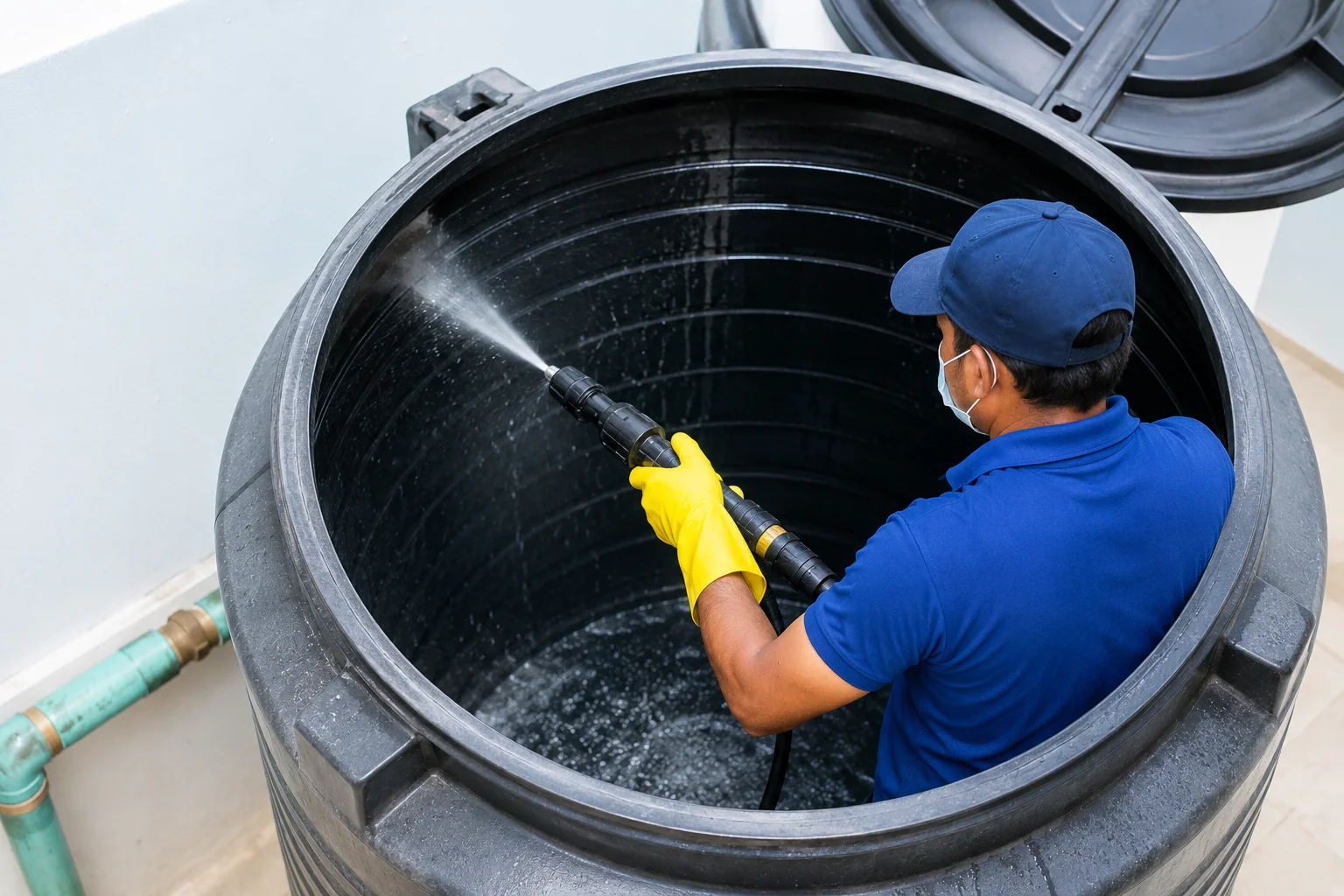
Underground Water Tank Cleaning in Dubai, Done Safely and Thoroughly
The tank under your garden, driveway or basement is the first stop for your water supply, and the place where most sediment ends up. It is also a confined space that should never be entered casually. We clean underground tanks with proper safety procedures and inspect them while they are empty.
In short: Best Fix Prime provides underground water tank cleaning in Dubai for villa ground tanks and building basement tanks. We pump the tank down, ventilate it and work with a team member stationed at the opening throughout, remove sludge, scrub every surface, inspect for cracks and seepage, disinfect, rinse and refill, then make sure the cover seals properly. Call or WhatsApp +971 50 108 4133.
Underground water tank cleaning in Dubai deals with the dirtiest and most hazardous tanks in any property. Because underground tanks receive water straight from the mains, they collect most of the sand and silt in the supply. They are dark, so biofilm grows unchecked. Their covers sit at ground level, where garden water, soil and insects can get in. And they are confined spaces, with limited ventilation and a single access point, which makes entering them dangerous without the right precautions. This page explains how we clean them safely and what we look for while they are empty.
What counts as an underground water tank?
| Tank type | Where you find it | Typical access |
|---|---|---|
| Villa ground tank | Buried in the garden, under the driveway or beside the villa | Manhole cover at ground level |
| Semi-buried tank | Partly below ground, partly exposed | Top hatch or side manhole |
| Building basement tank | Inside the basement or under the car park | Hatch from a plant room or car park |
| Ground-level concrete tank | Built into the building structure at ground floor | Hatch or manhole |
| Buried plastic or GRP tank | Some newer villas and smaller buildings | Raised access riser |
Why are underground tanks dangerous to enter?
An underground tank is a confined space. There is usually only one way in and out, natural ventilation is poor and the air inside can be low in oxygen or contain gases from decaying sludge. Floors are slippery, ladders may be corroded and lighting is minimal. Every year, people around the world are injured or killed entering tanks and similar spaces without precautions, often while trying to rescue someone who collapsed first. That is why homeowners and untrained staff should never climb into an underground tank, even to retrieve something or have a quick look.
How do we clean an underground tank safely?
Inspect from above
The cover, frame, access ladder, depth, water level and visible condition are checked before anything is opened fully.
Isolate and pump down
The inlet is closed and the tank is pumped down, leaving the sludge layer for removal.
Ventilate and make safe
The tank is ventilated, safe access set up, and a team member is stationed at the opening for the whole job.
Remove sludge
Settled sludge and sediment are pumped or removed by hand from the floor and sump.
Scrub and inspect
Walls, floor, ceiling and fittings are scrubbed, and the structure is inspected for cracks, seepage and corrosion.
Disinfect, rinse and refill
Surfaces are disinfected, rinsed, and the tank is refilled with the cover secured and sealed.
Safety is planned before the cover comes off. The tank is ventilated before entry and throughout the work, the person inside is never alone, a team member stays at the opening at all times, and safe means of getting in and out are set up. Work stops if conditions inside change. These steps add time to the job, but they are not optional, and we never cut them short to finish sooner, whatever the size of the tank or the time of day.
How much sludge builds up in an underground tank?
More than most owners expect. Underground tanks receive water directly from the mains, and any fine sand, silt or rust particles settle on the floor. Over a year or more, this can form a thick layer of grey or brown sludge. Every time the tank refills, the incoming water stirs some of it up, sending sediment towards the pump and the rest of the system. Removing this layer is the main reason underground tank cleaning makes such a noticeable difference to water quality at the taps.
How is sludge removed from an underground tank?
Once the water is pumped down, thicker sludge is removed with a sludge pump or by hand into containers, depending on the volume and consistency. Corners and the sump, a lower area many tanks have near the outlet, need particular attention because sludge collects there. The sludge is taken out of the tank and disposed of responsibly rather than being washed across gardens or driveways. Only once the floor is clear do we move on to scrubbing walls.
What do we check while the tank is empty?
An empty underground tank is a rare chance to inspect the structure properly. We check the walls, floor and ceiling for cracks and spalling concrete, look for signs of water seeping in from outside, inspect the condition of internal ladders, brackets and pipe fittings for corrosion, and check the inlet float valve, the outlet and the overflow. The cover and its frame are checked for gaps and damage. Everything we find is photographed and included in your report.
Can groundwater or garden water get into an underground tank?
Yes. Concrete tanks can crack over time, especially if the ground moves, tree roots grow nearby or heavy vehicles pass over them. Cracks can let groundwater, irrigation water or soil seep in, carrying bacteria and organic matter. Signs include muddy water, soil on the tank floor, water levels rising when the mains is off and a strong earthy smell. If we find seepage, we explain the repair options, such as sealing cracks or applying a lining, so the tank can stay clean.
Why are manhole covers so important?
The cover is the weakest point of most underground tanks. If it sits flush with the ground, rain and irrigation water can run straight in. If its seal has perished, insects and dust get in. If it is lightweight, children or pets could lift it, which is a serious safety hazard. A good cover sits slightly above surrounding ground, seals tightly and is heavy or lockable. During underground water tank cleaning in Dubai, we check the cover and frame and recommend a replacement or a raised frame where needed.
What about underground tanks under driveways?
Many villa ground tanks sit under driveways and parking areas. Vehicles parked or driving over the cover can crack the frame, loosen the seal and, over time, damage the tank roof. Oil and dirt from vehicles can wash towards the cover in rain. We check these covers carefully and recommend heavy-duty covers rated for vehicle loads where the tank is under a driveway. Please move cars away from the cover before the clean.
How are building basement tanks different?
Basement tanks in towers and apartment buildings are much larger and often divided into compartments. Access is usually from a plant room or car park, sometimes through tight hatches. Because they supply many people, they are cleaned one compartment at a time to keep water flowing, and the work is coordinated with building management. The safety principles are the same as for villa ground tanks, scaled up for the size of the space.
How often should underground tanks be cleaned?
Because they collect the most sediment, underground tanks benefit from cleaning at least once or twice a year, and more often if the supply carries a lot of sand or the tank has had contamination problems. Cleaning the underground tank on the same visit as the roof tank, in the right order, gives the best result for the whole system.
Should you try to clean an underground tank yourself?
No. Even if the tank looks shallow, entering it carries real risks, and draining it without the right pump and disposal arrangements can flood gardens or driveways. Pouring chemicals into an underground tank without cleaning it first does little and can create harmful fumes. the safest thing an owner can do is keep the cover sealed and locked, keep the area around it clean and book a professional clean on a regular schedule.
What signs point to underground tank problems?
- Sand or grit in tap aerators and shower heads, even after cleaning them
- Cloudy or brown water when the tank is refilling
- An earthy or rotten smell from the water
- The tank overflowing or the area around the cover staying wet
- Water level rising when the mains supply is off
- Insects or soil visible when the cover is lifted
What lives in an uncleaned underground tank?
Underground tanks are dark, cool compared with roof tanks and rarely disturbed, which makes them a quiet home for things you would rather not drink. Biofilm grows on walls and the underside of the roof. Insects such as cockroaches can get in through poor covers and breed around the frame. Mosquitoes may lay eggs where water sits still near the opening. Occasionally, lizards or rodents fall in and cannot get out. None of this is visible from the tap, which is why regular inspection and underground water tank cleaning in Dubai matter even when the water looks clear.
How do we light and ventilate the tank during work?
Underground tanks are completely dark once you are a metre or two inside. Safe, suitable lighting is set up so every surface can be seen and cleaned properly, and so the inspection is meaningful. Ventilation is provided before entry and kept running throughout the work, to bring in fresh air and clear any fumes from sludge or cleaning products. Good lighting and ventilation are not just safety measures; they are also what allows a thorough job to be done.
What happens to the pump while the tank is cleaned?
In villas, the transfer pump that lifts water to the roof tank draws from the underground tank. Before cleaning, the pump is switched off so it does not run dry, which can damage it. Its suction pipe and foot valve inside the tank are checked and cleaned, as sludge often collects around them. After the tank is refilled, the pump is switched back on and its operation is checked. If the pump has been struggling, our plumbers can look at it during the same visit.
Can an underground tank be lined or sealed?
Yes. Concrete underground tanks with cracking, rough or porous walls, or minor seepage can often be sealed with a coating or lining suitable for drinking-water storage. A smooth, sealed surface is easier to clean and less likely to harbour biofilm, and it stops groundwater getting in. Lining is a separate job from cleaning and is done after the tank has been cleaned and allowed to dry. We will advise if your tank would benefit from it.
Is the ground tank refilled from the mains straight away?
Yes, once it is clean, disinfected and rinsed. Depending on the mains pressure and the tank size, refilling can take from under an hour to several hours. During this time, we check that the inlet float valve shuts off at the correct level, so the tank does not overflow. If the roof tank is being cleaned the same day, it is only emptied once the underground tank has enough clean water to refill it.
How do you keep the area around the manhole clean?
The ground around an underground tank cover should be kept clean, dry and slightly sloped away from the cover. Avoid planting directly around it, as soil and irrigation water will end up near the opening. Do not store garden waste, chemicals or rubbish on or beside the cover. Sweep sand and leaves away regularly, especially after windy days and dust storms. In car parks and driveways, keep oil and dirt away from the cover. These simple habits stop much of the contamination that would otherwise reach the tank.
What about tanks with no internal ladder?
Many smaller villa ground tanks have no fixed ladder, and some older tanks have ladders so corroded they are unsafe to use. We bring suitable access equipment, so the team can enter and leave safely without relying on fixed fittings. If an internal ladder is badly corroded, we recommend removing or replacing it, as rust from the ladder also ends up in the water.
How long does an underground tank clean take?
A typical villa ground tank usually takes a few hours, including pumping down, sludge removal, scrubbing, disinfection and refilling. Tanks with heavy sludge, awkward access or larger volumes take longer, and safe working procedures add time that should never be rushed. Large building basement tanks are cleaned over one or more days, compartment by compartment. Your quote includes an estimate based on the tank size and condition.
What should you do before the team arrives?
- Move vehicles, planters or furniture away from the manhole cover
- Store water for drinking, cooking and flushing
- Turn off garden irrigation near the tank
- Keep children and pets away from the work area
- Let household staff or residents know the timing
What does the inspection report tell you?
Because underground tanks are rarely seen, the report is often the first clear picture an owner has of their tank. It includes photos of the floor, walls and roof before and after cleaning, notes on cracks, seepage and corrosion, the condition of the cover and frame, the state of the float valve, suction pipe and overflow, and any recommended repairs in order of priority. Keeping these reports year to year shows whether the tank is stable or deteriorating.
Do underground tanks stay cooler than roof tanks?
Yes. Being below ground, they are shielded from direct sun and stay noticeably cooler than roof tanks in summer. That is one reason some villa owners ask about drawing cold water directly from the ground tank for certain outlets. Cooler water also slows bacterial growth, but it does not stop sediment settling or biofilm forming in the dark, so regular cleaning is still needed.
Why choose Best Fix Prime for underground tanks?
We follow safe working procedures on every underground tank, remove sludge fully rather than stirring it around, inspect the structure while it is empty and make sure the cover seals properly before we leave. Underground water tank cleaning in Dubai with us includes before-and-after photos and a condition report, and our plumbing team can repair float valves, pipework and covers, so the tank stays clean for longer.
The cost depends on the tank size and depth, the amount of sludge, access to the opening, the time needed for safe working and any repairs to covers, cracks or fittings. Villa ground tanks are usually quoted from photos and size, while building basement tanks are quoted after a site survey.
More tank cleaning services
Book an underground tank clean
Tell us where the tank is, its approximate size and depth and how long it has been since it was cleaned. Call or WhatsApp +971 50 108 4133, or use the form at the top of the page. If you are not sure where the underground tank is, look for a square or round cover in the garden, beside the villa or under the driveway, often near the water meter. A photo of the cover and the area around it is enough for us to start. We confirm the price and date, send a short preparation checklist and arrive with everything needed to clean the tank safely in one visit.
Best Fix Prime (Bestfix Prime Technical Services LLC)
AddressRoom 201, 3rd Avenue by Ya Building, Street 27, Mirdif, Dubai, United Arab Emirates
Call and WhatsApp+971 50 108 4133
Emailinfo@bestfixprime.ae
HoursOpen 24 hours, 7 days a week
Frequently asked questions
What is underground water tank cleaning in Dubai?
Underground water tank cleaning in Dubai is the safe cleaning of ground and basement tanks: pumping down, sludge removal, scrubbing, inspection, disinfection and refilling.
Why are underground tanks dangerous to enter?
They are confined spaces with poor ventilation, possible low oxygen and slippery surfaces.
Should I climb into my ground tank to check it?
No. Never enter an underground tank without trained people and safety precautions.
Why do below-ground tanks collect more sediment than roof tanks?
They receive water straight from the mains, so sand and silt settle there before reaching the roof.
How is the sludge removed?
It is pumped or removed by hand into containers and disposed of responsibly.
Can groundwater get into my tank?
Yes, through cracks. Signs include muddy water and rising levels with the mains off.
Why does my ground tank cover matter?
A poor cover lets in water, soil and insects and can be a safety hazard.
Can you replace a damaged manhole cover?
Yes, including heavy-duty covers for driveways and raised frames.
My tank is under the driveway. Is that a problem?
Vehicles can damage covers and frames. Heavy-duty covers help.
How often should underground tanks be cleaned?
At least once or twice a year, more often if sediment is heavy.
Do you clean basement tanks in buildings?
Yes, compartment by compartment, coordinated with building management.
Do you inspect the tank structure?
Yes, for cracks, seepage, corrosion and damaged fittings.
Can cracked underground tanks be repaired?
Often, by sealing cracks or lining the tank. We explain the options.
Do you clean buried plastic tanks?
Yes, with care not to damage the tank walls.
Should the roof tank be cleaned at the same time?
Yes, ideally, with the underground tank cleaned first.
Why does my water smell earthy?
Often sludge or soil contamination in the underground tank.
What if the manhole is under a parking space?
Please move vehicles before the clean so the cover can be lifted safely.
Will you flood my garden while draining?
No. Water is directed to drains and sludge is collected.
Do I get photos of inside the tank?
Yes, before and after, plus a condition report.
How do I book an underground tank clean?
Call or WhatsApp +971 50 108 4133 with the tank location and size.