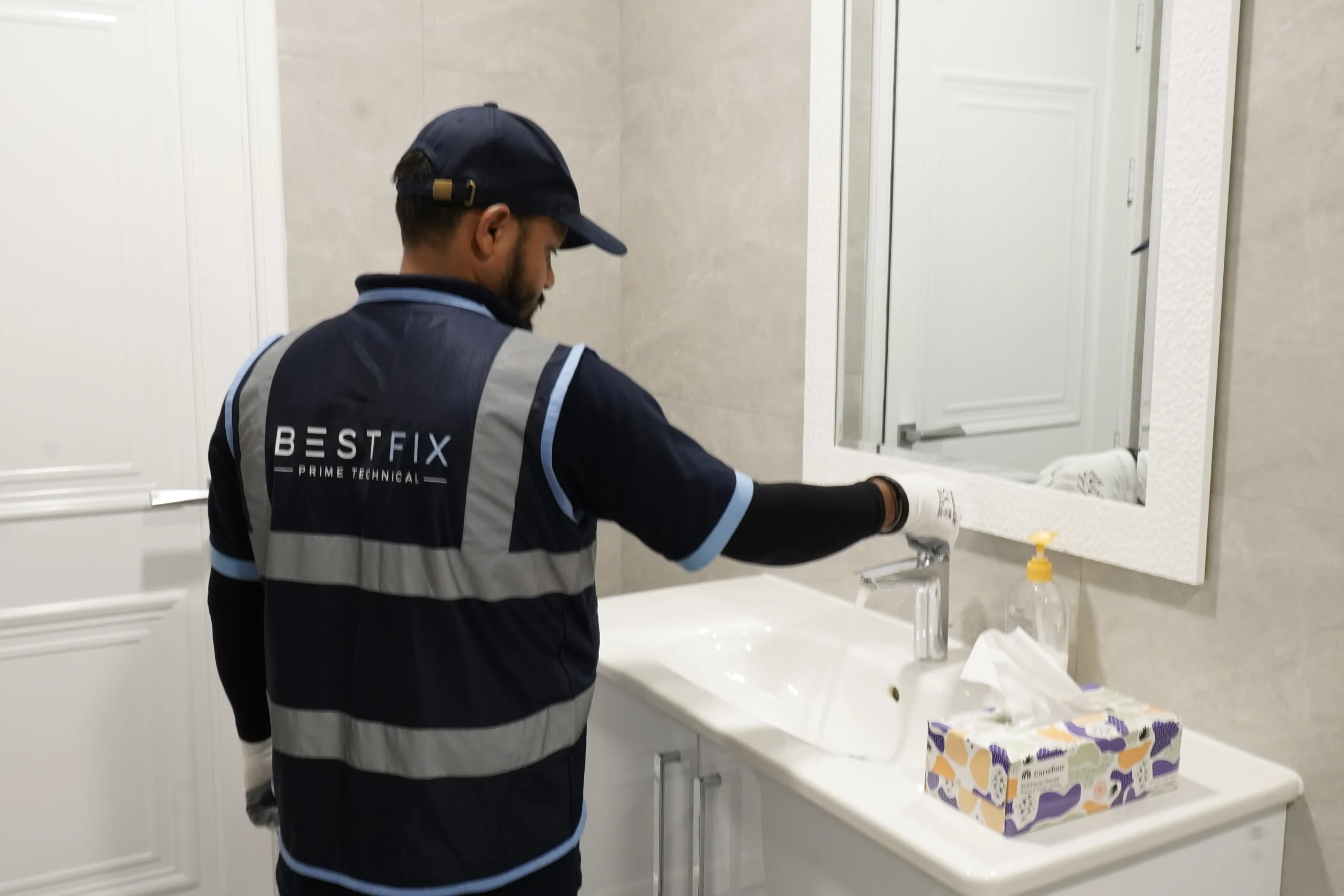
Emergency Plumber in Dubai for Burst Pipes, Floods and Blocked Drains
Water spreads fast. Call +971 50 108 4133 any time, and while the plumber is on the way we will help you shut it off and protect your home.
In short: Best Fix Prime provides an emergency plumber in Dubai 24 hours a day for burst pipes, major leaks, failed hoses, overflowing toilets, drains backing up, water heater leaks and tank overflows. The first step is always to shut off the water at the main or nearest valve; we talk you through it while a plumber is dispatched. Call or WhatsApp +971 50 108 4133.
Plumbing emergencies are measured in minutes. A burst flexible hose under a sink can release a lot of water quickly, and in an apartment it does not stay in your apartment for long. Ceilings below soak through, floors lift, cabinets swell and electrics get wet. The difference between a small repair and a major one is often how fast the water is stopped. That is why our emergency plumber in Dubai service starts on the phone, helping you shut the water off, before the plumber even arrives.
This page explains which plumbing problems count as emergencies, how to stop water in the first minutes, what the plumber will do on arrival and how to prevent the most common causes of plumbing emergencies in Dubai homes.
Which plumbing problems need an emergency plumber?
- A burst pipe or failed flexible hose spraying or pouring water
- A leak coming through the ceiling from above
- An overflowing toilet that will not stop
- Drains or toilets backing up, especially with sewage
- A water heater leaking heavily or from the pressure valve
- A roof tank or water tank overflowing
- No water at all in the property
- Water leaking near electrical fittings or the distribution board
How do you shut off the water in an emergency?
Try the nearest isolation valve
Most sinks, toilets, washing machines and water heaters have a small valve on the pipe feeding them. Turn it a quarter turn or clockwise until it stops.
Find the main valve if that fails
In villas, it is usually near the water meter at the boundary, in a utility room or near the pump. In apartments, look under the kitchen sink, in a utility cupboard or in the service riser cupboard outside your front door.
Turn off the water heater
If the leak involves hot water, switch off the water heater at its isolator to protect the element.
Open a cold tap
Opening a tap at the lowest point drains remaining water from the pipes and reduces the flow from the leak.
Deal with electrics
If water is near sockets, lights or the board, switch off at the main switch only if you can reach it without touching water.
What happens when our emergency plumber arrives?
- Talk you through shutting off water
While the plumber is dispatched, we help you find and close the main valve or the nearest isolation valve.
- Arrive and assess
The plumber confirms the water is off, checks for electrical risk and finds the source.
- Stop the leak or blockage
A temporary or permanent fix is made: clamp, new fitting, replaced hose or cleared drain.
- Restore supply safely
Water is turned back on gradually and the repair is checked under pressure.
- Check for hidden damage
Surrounding areas, ceilings below and nearby electrics are checked for water.
- Plan any follow-up
If a permanent repair needs parts or wall access, it is booked and you are told what to expect.
What causes most plumbing emergencies in Dubai?
| Cause | Where it happens | Why it fails |
|---|---|---|
| Flexible braided hoses | Under sinks, toilets, basins and washing machines | Corrosion and age weaken them until they burst |
| Water heater valves | Bathrooms, kitchens, roofs | Pressure valves fail or heaters corrode internally |
| Push-fit and compression joints | Behind cabinets and in ceilings | Joints loosen over time or were poorly made |
| Blocked drains | Kitchens, bathrooms, floor traps | Grease, hair, wipes and debris build up |
| Tank float valves | Roof tanks and ground tanks | Float valve sticks open and the tank overflows |
| Pipe damage | Walls and floors | Drilling, nails or shifting fixtures |
Why are flexible hoses such a common culprit?
Most taps, toilets and basins in Dubai homes are connected by short braided flexible hoses. They are convenient but have a limited life. The braided outer layer can corrode, especially in humid bathrooms and under sinks where cleaning chemicals are stored, and the rubber inner tube eventually fails. When it does, it often fails all at once, releasing water at full mains pressure. Replacing old or rusty hoses before they burst is one of the cheapest ways to avoid a plumbing emergency, and our plumbers can check every hose in the home on a routine visit.
What if the leak is coming from the apartment above?
Water coming through your ceiling from above is common in towers. The source is in the other apartment, so the first step is to contact the neighbour or building management to stop it at their end. Meanwhile, protect your belongings, switch off any lights or electrics in the wet ceiling and collect the water. Our plumber can help identify the source and repair your side, and we provide a written report with photos that is useful when the neighbour, building and insurers get involved.
What should you do if a toilet is overflowing?
Do not flush again. Turn off the small isolation valve on the pipe behind or beside the toilet. Lift the cistern lid and raise the float to stop more water entering if the valve will not turn. If the bowl is blocked and overflowing, keep children and pets away and protect the floor. If drains elsewhere in the home are also bubbling or backing up, the blockage may be further down the system, and the plumber will need to clear the main drain line.
Why do drains back up in Dubai buildings?
Kitchen drains in particular fill with cooking oil and grease, which hardens in the pipes and traps food waste. Bathroom drains collect hair and soap. Wet wipes, sanitary items and cotton buds flushed down toilets cause many blockages. In older buildings, shared drain stacks can block lower down, so water from upper floors backs up into lower apartments. Emergency drain clearing deals with the blockage, and the plumber will tell you if it is in your pipework or the building's.
What about water heater emergencies?
Water heaters are found in bathrooms, kitchens and sometimes on roofs. Heavy leaking from the tank, water constantly discharging from the pressure relief valve, or a burning smell from the heater are all reasons to switch it off at the isolator, close its water supply and call. A heater that has corroded through usually needs replacing, while a faulty valve or element can often be repaired.
What if there is no water at all?
First, check whether neighbours also have no water, which suggests a building or area supply issue. In villas, check whether the pump is running and whether the roof or ground tank has water. A failed pump, a tripped pump breaker, an empty tank due to a stuck float valve or a valve closed by mistake are the most common causes. Our plumber checks the supply path from the tank or meter to the taps and restores flow.
Should you call a plumber or building maintenance?
In many towers, building maintenance handles common areas, shared risers and the main supply, while anything inside your apartment, such as sinks, toilets, hoses and water heaters, is your responsibility or your landlord's. If the leak is clearly in a shared area, call building maintenance. If it is inside the apartment, or you are not sure, call us and we will tell you which side it is on.
How can you prevent plumbing emergencies?
- Replace braided flexible hoses that look rusty, kinked or are many years old
- Know where every isolation valve and the main valve are
- Do not pour cooking oil down the sink
- Never flush wet wipes or sanitary products
- Have water heaters checked periodically
- Turn off the main water supply before travelling for long periods
- Check roof tank float valves during routine maintenance
Why does an emergency plumber in Dubai need to move fast?
Water in Dubai buildings travels quickly and hides well. In towers, it runs along slabs, through service penetrations and down risers, often appearing in an apartment two or three floors below. In villas, it soaks into gypsum ceilings, wooden cabinets and the screed under tiles. Every minute of flow adds to the drying time and the repair bill. That is why our emergency plumber in Dubai service prioritises stopping the water first, then finding and fixing the cause, then checking where the water has gone.
How do you protect your home while waiting for the plumber?
- Move electronics, rugs, documents and furniture away from the water
- Use towels, buckets and containers to catch drips and limit spread
- If water is coming through a ceiling that is bulging, place a bucket underneath and keep people clear
- Lift curtains and bed covers off the floor if water is spreading
- Take photos and videos of the leak and damage for your records
- Open windows or run fans to start ventilating wet areas once the water is off
Is a bulging ceiling dangerous?
It can be. When water collects above a gypsum ceiling, it forms a sagging bulge that can give way suddenly and bring wet board down with it. Keep people and pets out from under it, switch off any lights in that ceiling at the board and place a large container underneath. Do not poke it unless a technician advises it, as releasing a large volume of water without preparation can cause more damage. Our plumber will drain it safely once the source is stopped.
What about leaks from AC drains?
Not every ceiling leak is plumbing. In many Dubai homes, water through the ceiling comes from a blocked AC drain line or an overflowing drain tray above a ducted unit or fan coil. If the leak gets worse when the AC is running and slows when it is off, the AC is the likely source. Because we also handle AC, the right technician can be sent, or both can attend together if the source is unclear.
Can you fix the leak permanently on the same visit?
Often, yes. Failed hoses, valves, toilet fittings, drain blockages and accessible pipe joints are usually repaired permanently on the first visit, as our plumbers carry common parts. Leaks inside walls or floors, or on unusual fittings, may be stopped with a temporary repair and completed on a follow-up visit once the area is opened safely and the right parts are sourced. You will always know which kind of repair has been done.
What about commercial plumbing emergencies?
Restaurants with blocked kitchen drains, shops with water coming through the ceiling, clinics with a burst pipe in a treatment room, and offices with an overflowing toilet all need fast help. Our plumbers prioritise getting the business safe and trading, protecting stock and equipment, and then plan larger repairs for outside opening hours.
What happens after the emergency is over?
Once the water is stopped and the repair is made, wet areas need to dry before ceilings, walls and paintwork are repaired. The plumber advises on drying and checks for hidden damage. Electrics that got wet should be tested by an electrician before use. When everything is dry, our painting and maintenance teams can repair stained ceilings and damaged paint, so the home is put back as it was.
What do plumbing emergencies look like in villas?
Villa plumbing emergencies often involve the equipment that apartments do not have: a ground or roof tank overflowing because its float valve stuck, a pump that has failed so the house has no pressure, a garden irrigation pipe that has burst and is flooding the driveway, or an outdoor tap broken by a car. They also tend to involve longer pipe runs, so finding the right valve to isolate a section matters. Our plumbers are used to tracing villa systems and isolating only the affected part, so the rest of the house can keep running.
What do plumbing emergencies look like in apartment towers?
Apartment emergencies are mostly about water escaping where it can reach neighbours. Kitchen sink hoses, washing machine connections, toilet cisterns and water heaters are the usual sources. Because the main valve can be in a shared riser cupboard, tell us the building name when you call, and we can guide you to it or arrange access through security.
What details help the plumber come prepared?
- Where the water is coming from, if you can see it
- Whether you have managed to shut off the water
- Whether it is hot or cold water, or a drain
- Photos of the leak, the fitting and any damage
- The building name, floor and any access arrangements
Will the plumber clean up?
The plumber removes standing water from the immediate work area, takes away old fittings and leaves the repair tidy. Larger clean-ups after a major flood, such as drying out carpets or ceilings, take time and may need dehumidifiers or a specialist. We advise on what is needed and can arrange follow-up repairs once everything is dry.
Can landlords and tenants call you directly?
Yes. Plumbing emergencies rarely wait for a landlord to answer. Tenants can call us directly to stop the water and make the property safe, and landlords can call on a tenant's behalf. Either way, we send a written summary with photos showing the cause, the work done and any follow-up needed, so both sides have the same information and responsibility can be agreed calmly afterwards.
Why choose Best Fix Prime as your emergency plumber in Dubai?
Because a person answers at any hour and helps you shut off the water straight away, because our plumbers carry the parts that fail most often, and because we also cover electrics, AC drains and the repairs that follow a leak. One call deals with the immediate emergency and everything it affects, instead of leaving you to find three different companies the next morning.
Does turning the water off at night damage anything?
No. Turning off the main water supply while waiting for a plumber is safe. Switch off the water heater too, so it does not run without water. Toilets will not refill and taps will not run until the supply is restored, so fill a few bottles or a bucket first if you can do it quickly and safely.
Emergency call-outs outside normal hours usually cost more than planned visits. The repair is priced after the plumber finds the cause: replacing a failed hose or valve is usually quick, while repairing a pipe inside a wall or clearing a deep drain blockage takes longer. You are told the price before the repair goes ahead, and stopping the water always comes first, before any discussion of cost.
More 24/7 help when the plumbing fails
Call an emergency plumber now
Shut off the water if you can, then call or WhatsApp +971 50 108 4133. Tell us where you are, where the water is coming from and whether it is near electrics.
Best Fix Prime (Bestfix Prime Technical Services LLC)
AddressRoom 201, 3rd Avenue by Ya Building, Street 27, Mirdif, Dubai, United Arab Emirates
Call and WhatsApp+971 50 108 4133
Emailinfo@bestfixprime.ae
HoursOpen 24 hours, 7 days a week
Frequently asked questions
Is there an emergency plumber in Dubai available at night?
Yes. Our emergency plumber in Dubai service is available 24/7, including weekends and public holidays.
What should I do first when a pipe bursts?
Close the nearest isolation valve or the main water valve, switch off the water heater if hot water is involved, and call us.
Where is the main water valve in a Dubai apartment?
Often under the kitchen sink, in a utility cupboard or in the service riser cupboard outside the front door.
Where is the main water valve in a villa?
Usually near the water meter at the boundary, in a utility room or near the water pump.
Why did my flexible hose burst?
Braided hoses corrode and age, especially in humid areas, until the inner tube fails suddenly.
What do I do if my toilet is overflowing?
Stop flushing, close the isolation valve behind the toilet and lift the float if needed, then call.
Water is coming through my ceiling. What should I do?
Switch off lights in that area, protect belongings, contact the neighbour or building if it is from above, and call us.
Why is my drain backing up?
Usually grease, hair, wipes or debris. Several drains backing up can mean the blockage is further down the system.
Is a leaking water heater an emergency?
Heavy leaking or constant discharge from the pressure valve is. Switch it off and close its supply.
Why do I have no water?
It could be a building supply issue, a failed pump, an empty tank or a closed valve.
Do you clear blocked drains in an emergency?
Yes, including kitchen, bathroom and floor drains and backed-up toilets.
Is the plumber or building maintenance responsible?
Building maintenance usually handles shared areas; inside the apartment is usually the owner or landlord.
Can water leaks damage electrics?
Yes. Switch off electrics near the water if safe, and have them checked before use.
Do emergency plumbers cost more?
Usually outside normal hours. The repair is priced after the cause is found and confirmed before work.
Can you fix a leak inside the wall at night?
The water can be stopped and the area made safe. A permanent repair inside a wall may be scheduled for a follow-up visit.
What causes roof tanks to overflow?
Usually a float valve stuck open, letting water keep filling the tank.
Should I turn off the water when travelling?
Yes. Turning off the main supply before long trips prevents leaks while you are away.
Do you provide reports for insurance?
Yes. You receive a written summary with photos of the cause and the repair.
Do you handle plumbing emergencies for restaurants?
Yes, including kitchen drain blockages and leaks during service.
How do I call an emergency plumber?
Call or WhatsApp +971 50 108 4133 at any time.