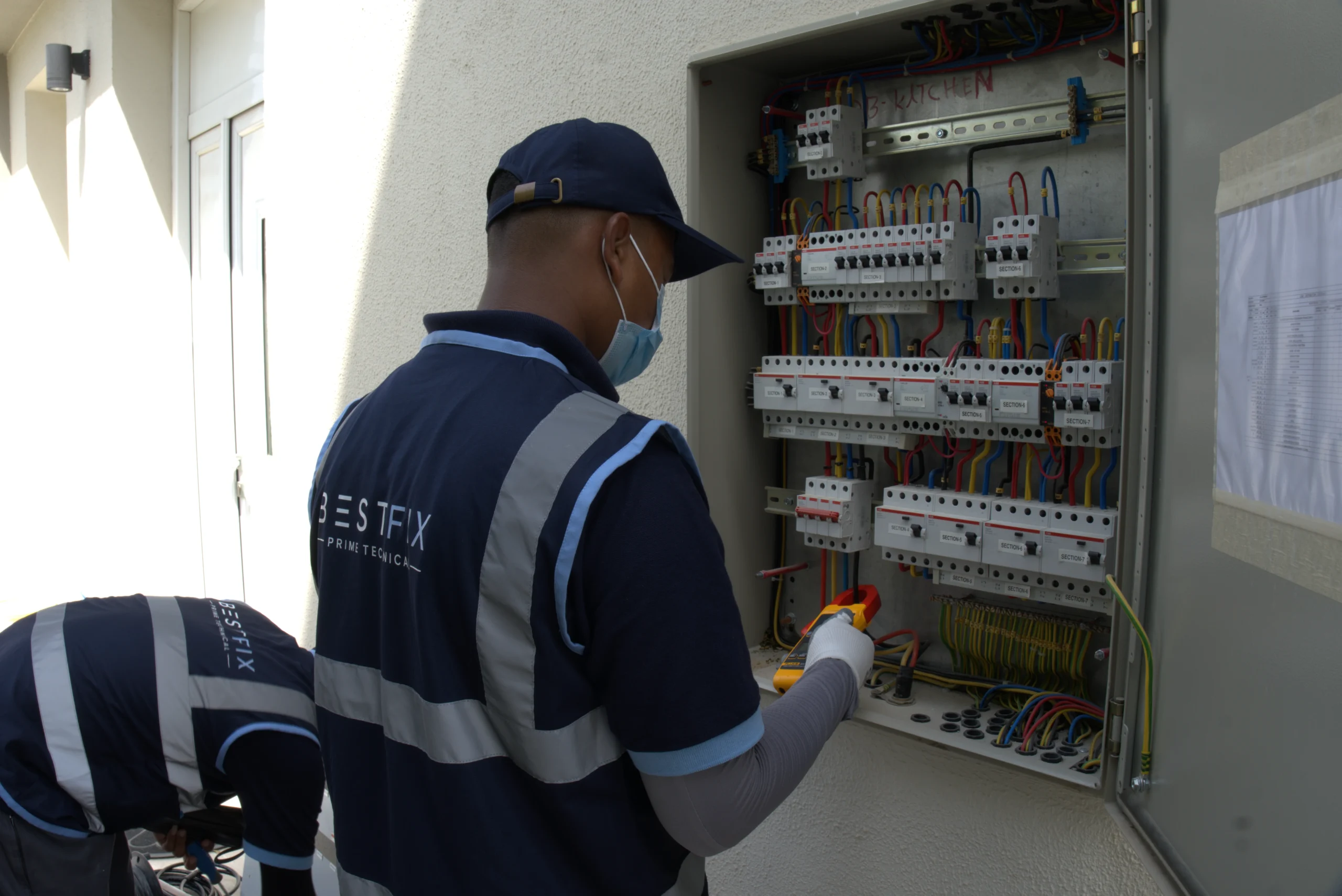
Electrical Wiring and Rewiring in Dubai, Planned Around Modern Loads
From one new circuit for a kitchen upgrade to a full rewire of an older villa, we plan the wiring around how you actually live and what you plug in today.
In short: Best Fix Prime provides electrical wiring and rewiring in Dubai for homes and businesses. We add new circuits and sockets for kitchens, home offices and appliances, wire renovations and fit-outs, and carry out partial or full rewires where cables are old, damaged or overloaded. Every job is planned around current and future loads, protected by suitable breakers and RCDs, and fully tested before handover.
Many Dubai homes were wired for a different way of living. Fewer appliances, fewer AC units, no home offices with three screens, no induction hobs or electric car chargers. Years later, the same circuits are carrying far more, often through extension leads and adaptors, and the result is tripping breakers, warm sockets and the occasional scorch mark. Electrical wiring and rewiring in Dubai is about bringing an installation up to the way the property is used now.
This page explains when you need new wiring, when rewiring is the right call, how we plan circuits, what partial and full rewires involve and how to keep disruption to a minimum.
New wiring or rewiring: what is the difference?
| New wiring | Rewiring | |
|---|---|---|
| What it means | Adding circuits, sockets or points that did not exist | Replacing existing cables and circuits |
| Typical trigger | Renovation, extra appliances, home office, extension | Old, damaged or overloaded wiring |
| Scope | One circuit to several rooms | One room, a floor or the whole property |
| Disruption | Usually limited to the new route | Depends on scope and access |
When do you need new wiring?
- You are adding appliances that need their own circuit, such as an oven, induction hob or water heater
- You need sockets where furniture now stands, instead of extension leads
- A home office needs more sockets and a stable supply
- A kitchen or bathroom is being renovated
- A garage, majlis, roof room or outbuilding is being converted
- You are adding AC units or upgrading to larger ones
- You want outdoor lighting, garden sockets or a gate motor
What are the signs a property needs rewiring?
- Breakers trip regularly even after individual faults are fixed
- Several sockets show heat marks or feel warm under normal use
- Cable insulation is brittle, cracked or crumbling where visible
- There is no RCD protection on most circuits
- Earth connections are missing on sockets or light fittings
- Previous work used taped joints, mixed cable sizes or improvised connections
- Extension leads and adaptors are used everywhere because there are too few sockets
- The property has had water or fire damage affecting the cables
How do we plan circuits?
Good wiring starts on paper. Our electrician walks through each room with you, asking where furniture goes, what you plug in, where you work, cook and charge devices, and what you might add later. Heavy loads such as AC units, cookers, water heaters and washing machines get their own circuits. Sockets are grouped sensibly so no single circuit carries too much. Lighting is planned separately from power. Each circuit is given a suitable cable size and protective device, with RCD protection where it is needed.
How does the rewiring process work?
Survey
The electrician inspects the board, tests existing circuits and walks through the property to understand what you need now and in future.
Plan the circuits
Sockets, switches, lights and appliance points are marked, loads are worked out and circuits are planned with suitable cable sizes and protection.
Agree scope and price
You receive a written scope covering the circuits, cable routes, any wall or ceiling work and the price.
First fix
With power safely isolated, new cables are run through walls, ceilings or trunking and back boxes are fitted.
Board work
Circuits are connected to the distribution board with correctly rated breakers and RCD protection, or a new board is fitted.
Second fix
Sockets, switches and fittings are connected once walls are finished.
Test and label
Every circuit is tested for continuity, insulation and earth, breakers are labelled and the work is handed over.
What is a partial rewire?
Not every property needs everything replaced. A partial rewire focuses on the parts that are failing or no longer fit for purpose, such as the kitchen circuits, a damaged section of a villa, the outdoor wiring, or the circuits feeding AC units. It is often the most cost-effective option when the rest of the installation tests well. Testing at the survey stage shows which circuits are sound and which need replacing.
What does a full rewire involve?
A full rewire replaces the cables, back boxes, sockets, switches and usually the distribution board throughout the property. It is a bigger job, often taking several days for an apartment and longer for a villa, and it usually involves some chasing into walls or lifting ceiling panels. The result is an installation designed around current needs, with modern protection and clear labelling, that should not need major work for many years.
Can rewiring be done without damaging walls?
Disruption can be reduced, though rarely avoided completely. Where possible, cables are pulled through existing conduits, routed through ceiling voids and dropped down inside walls, or run in neat surface trunking where hidden routes are not practical. Where walls do need chasing, the damage is limited to the cable route and made good afterwards, ready for painting. We agree the approach with you before starting, so there are no surprises on the day work starts.
Is rewiring best done during a renovation?
Yes, by far. When walls and ceilings are already open, flooring is up and furniture is out, rewiring causes little extra disruption and costs less. If you are planning a kitchen, bathroom or full home renovation, bring the electrical plan in early so cables go in at first fix, before plastering and tiling, and fittings are connected at the end.
What about distribution board upgrades?
Many rewires include a new distribution board. Older boards may be crowded, lack RCD protection, use outdated breakers or show signs of heat damage. A new board gives each circuit suitable protection, room for future circuits and clear labelling. Even where a full rewire is not needed, a board upgrade is sometimes recommended on its own, particularly where circuits currently have no RCD protection.
How do we wire for AC units?
AC units are the heaviest everyday loads in most Dubai homes, and their compressors draw a surge on start-up. Each unit should be on a circuit sized for it, with a local isolator rated for the load and suitable for outdoor conditions. When adding units or upgrading capacity, we check whether the existing circuit can cope and run a new one if not. Because we also install AC, the wiring and the AC work can be planned together.
Can you wire home offices and entertainment areas?
Yes. Home offices need enough sockets at desk height, ideally on a circuit not shared with heavy appliances, and sometimes data points alongside. Entertainment walls need sockets behind the TV, concealed cable routes and power for speakers or consoles. Planning these properly ends the tangle of extension leads and adaptors that so often causes overheating, and it makes the room look far tidier too.
Can you wire outdoor areas?
Yes. Garden lighting, outdoor sockets, gate motors, pool equipment and outbuildings all need cables suited to outdoor or underground runs, weather-resistant fittings and RCD protection. Cable routes are planned to avoid future digging, irrigation and planting, and connections are sealed against sand and moisture so outdoor circuits stay reliable through every season.
How long does wiring and rewiring take?
| Job | Typical duration |
|---|---|
| One new circuit or a few sockets | Half a day to a day |
| Kitchen rewire during renovation | One to two days, split across first and second fix |
| Partial rewire of a few rooms | Two to four days |
| Full rewire of an apartment | Several days |
| Full rewire of a villa | One to several weeks, depending on size and access |
Can you live in the property during a rewire?
For new circuits and partial rewires, usually yes, with power off only in the rooms being worked on. For full rewires, it depends on the size of the property and your tolerance for dust and disruption. We can phase the work room by room and keep essential circuits, such as the fridge and at least one AC, running wherever possible.
Why does electrical wiring and rewiring in Dubai matter more as homes age?
Cables in Dubai homes live a hard life. Those running through roof spaces and ceiling voids sit in high heat for months, which slowly hardens their insulation. Connections loosen with years of expansion and contraction. Meanwhile, the load on the circuits keeps growing as households add AC units, larger appliances and home offices. A property that was perfectly wired fifteen years ago can be working at its limits today. Electrical wiring and rewiring in Dubai is often less about fixing something broken and more about catching up with how the home is now used.
What cable sizes and protection do circuits need?
Every circuit is matched to the load it will carry. Lighting circuits use smaller cables than socket circuits; cookers, water heaters and AC units need larger cables again. The breaker protecting each circuit is chosen to suit the cable, so it trips before the cable can overheat. RCD protection adds a further layer, switching off if current leaks to earth. Getting this matching right is what makes a new installation safe for years rather than just working on the day.
How do we deal with old, mixed or undocumented wiring?
Many older properties have been altered several times by different people, so circuits may be mixed, extended or undocumented. Before planning a rewire, our electrician traces and tests each existing circuit to understand what feeds what. This often reveals surprises, such as sockets in two rooms sharing a circuit with a water heater, or a lighting circuit feeding a garden socket. Mapping it first means the new layout is clean and every circuit is clearly labelled.
Can you add circuits without rewiring the whole property?
Yes, if the distribution board has space and the existing installation tests well. New circuits for a kitchen upgrade, home office or extra AC unit can usually be added on their own. If the board is full or lacks suitable protection, a board upgrade may be needed first, but that is still far less work than a full rewire.
What happens to old cables during a rewire?
Where old cables can be pulled out through conduits or ceiling voids, they are removed. Where they are buried in walls and cannot be removed without major damage, they are disconnected at both ends, made safe and left in place, with the new cables run along new routes. Redundant cables are never left live or connected, and their locations are noted in the handover record.
How is rewiring planned in apartments?
Apartments often have concrete walls and slabs, so chasing is more limited and ceiling voids, bulkheads and trunking are used more. Building management usually needs notice, and noisy work may be restricted to set hours. We plan the routes and timing to suit the building, and coordinate access for the electrician and any materials.
Do you provide a record of the new wiring?
Yes. At handover, you receive a summary of the circuits installed, which breaker controls which area, test results and photos of cable routes taken before walls were closed. That record is invaluable later when you want to hang shelves, add sockets or find a fault, and it is useful for landlords and future buyers too.
Can rewiring help if breakers keep tripping?
If tripping is caused by overloaded or damaged circuits rather than a single faulty appliance, yes. Splitting heavy loads onto separate circuits, replacing cables that have degraded and adding proper protection usually ends repeated tripping. If the cause is a specific appliance or fitting, fault finding and a targeted repair are the cheaper fix, which is why we test before recommending a rewire.
Can you plan for future needs during rewiring?
It is one of the best reasons to rewire properly rather than patch. While cables are being run, it costs little to add spare capacity: a spare way in the distribution board, a circuit ready for an extra AC unit, a supply point in the garage for a future electric car charger, or sockets in rooms that may become a nursery or office later. Thinking a few years ahead now avoids opening walls again later.
What about electric car chargers?
Home chargers draw a high, sustained load for hours at a time, so they need a dedicated circuit with suitable cable and protection, and the property's supply must be able to support them alongside AC and other loads. We can assess whether your existing board and supply can take a charger and run the circuit to your chosen location. The charger itself is usually supplied by the car or charger company.
How do kitchen renovations change the wiring?
Modern kitchens often carry far more electrical load than the ones they replace: induction hobs, double ovens, larger fridges, dishwashers, coffee machines and boiling water taps. Each heavy appliance should have a suitable circuit or connection, and worktop sockets should be positioned where they are actually used, away from sinks and hobs. Planning the kitchen wiring with the kitchen designer before installation avoids sockets hidden behind cabinets or appliances run from adaptors.
How is dust and mess controlled?
Rewiring can be dusty, especially where walls are chased. Furniture is moved or covered, doors to other rooms are closed or sealed, dust extraction is used on cutting tools and work areas are cleaned daily. At the end, chases are filled and left ready for painting, and our painting team can finish the walls if you want everything handled in one go.
Do landlords need to rewire between tenancies?
Not routinely, but the gap between tenants is the best time for any wiring work the property needs. Adding sockets, replacing tired fittings, splitting overloaded circuits or carrying out a partial rewire is far easier in an empty property. We can survey, quote and complete the work while the property is vacant, and provide a record of the work for your files.
The price depends on the scope, the number of circuits and points, cable routes and access, whether walls need chasing and making good, the distribution board, and whether the work fits around a renovation. A single new circuit is a small job; a full villa rewire is a significant project that is worth planning carefully. After the survey, you receive a written scope and price so you can compare options, such as a partial rewire now and the rest later, or phasing the work around a renovation.
Electrical services that pair with a rewire
Book a wiring survey
Tell us whether you need new circuits, a partial rewire or a full rewire, the type of property and any renovation plans. Photos of your distribution board help. WhatsApp or call +971 50 108 4133, or email info@bestfixprime.ae.
Best Fix Prime (Bestfix Prime Technical Services LLC)
AddressRoom 201, 3rd Avenue by Ya Building, Street 27, Mirdif, Dubai, United Arab Emirates
Call and WhatsApp+971 50 108 4133
Emailinfo@bestfixprime.ae
HoursOpen 24 hours, 7 days a week
Frequently asked questions
What does electrical wiring and rewiring in Dubai include?
Electrical wiring and rewiring in Dubai covers new circuits and sockets, renovation wiring, partial and full rewires and distribution board upgrades, all tested before handover.
How do I know if my home needs rewiring?
Regular tripping, heat marks on sockets, brittle insulation, missing earths, no RCD protection and improvised past work are common signs.
What is the difference between a partial and full rewire?
A partial rewire replaces only the failing or outdated circuits. A full rewire replaces cables and accessories throughout.
How long does a full rewire take?
Several days for an apartment and one to several weeks for a villa, depending on size and access.
Can I stay at home during rewiring?
Usually for partial work. For full rewires, it depends on the property; work can be phased room by room.
Will rewiring damage my walls?
Some chasing may be needed, but we use existing routes and ceiling voids where possible and make good afterwards.
Should I rewire during a renovation?
Yes. It is far less disruptive and usually costs less when walls and ceilings are already open.
Do you add new sockets?
Yes, with the circuit checked for capacity or a new circuit run where needed.
Does every AC unit need its own circuit?
Each unit should be on a circuit sized for it, with a suitable isolator.
Do you upgrade distribution boards?
Yes, often as part of a rewire or on its own where the board is old or lacks RCD protection.
Can you wire a home office?
Yes, with sockets at desk height on a suitable circuit and data points if needed.
Do you wire outdoor lighting and sockets?
Yes, using outdoor-rated cables and fittings with RCD protection.
Do you use surface trunking?
Where hidden routes are not practical, neat trunking that can be painted is used.
What is first fix and second fix?
First fix is running cables and fitting boxes before walls are finished. Second fix is connecting sockets, switches and fittings after.
Do you test after rewiring?
Yes. Every circuit is tested for continuity, insulation and earth, and breakers are labelled.
Can you wire a converted garage or roof room?
Yes, including lighting, sockets and AC circuits planned for the new use.
Do you rewire offices and shops?
Yes, often scheduled outside trading hours or during fit-outs.
Do you wire for induction hobs and electric ovens?
Yes, with a dedicated circuit sized for the appliance.
Will I get a written scope and price?
Yes. After the survey you receive a written scope covering circuits, routes and price.
How do I book a wiring survey?
WhatsApp or call +971 50 108 4133 with your property type, what you need and a photo of your board.