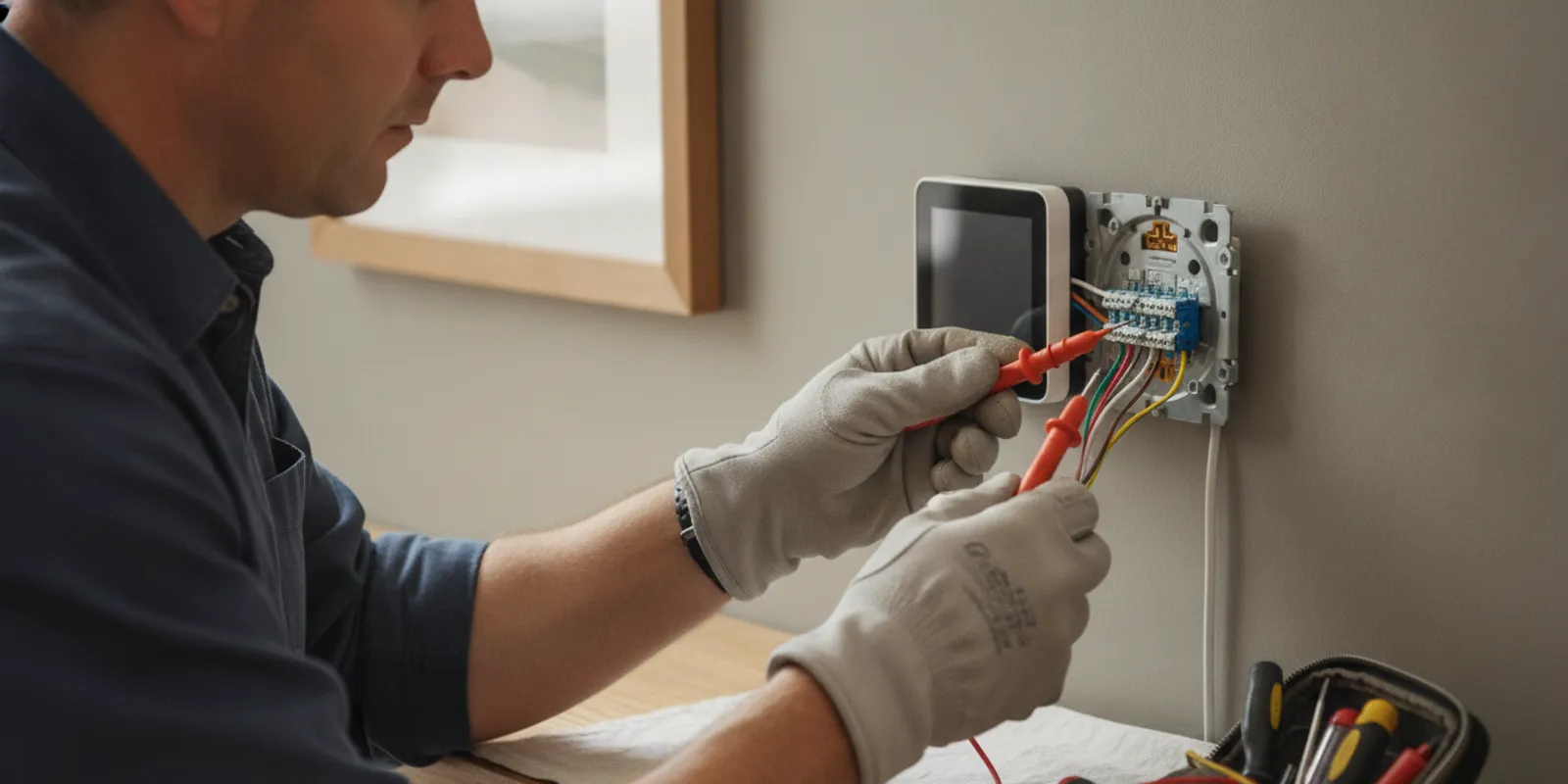
AC Thermostat Repair in Dubai for Wall Controls, Remotes and Smart Thermostats
When the AC ignores your settings, reads the wrong temperature or will not switch on at all, the problem is often the control rather than the unit.
In short: Best Fix Prime provides AC thermostat repair in Dubai for wired wall thermostats, split unit remotes and receivers, wired controllers, smart thermostats and the fan coil thermostats used in district cooling apartments. We fix wrong temperature readings, blank displays, controls that do not respond and units that cycle on and off. Our technicians cover all of Dubai and can be reached 24/7 on +971 50 108 4133.
A thermostat is a small device with a big job. It decides when the AC runs, how long for and how cold the room gets. When it fails, a perfectly healthy air conditioner can look broken: it will not start, will not stop, or keeps the room either freezing or stuffy no matter what you set. That is why AC thermostat repair in Dubai is often the quickest route back to a comfortable room. It is also one of the most commonly misdiagnosed faults, because the symptoms look so much like a failing air conditioner, and people sometimes pay for gas or parts that were never the problem.
This page covers the different controls used in Dubai homes and offices, the faults we see most often, how to tell whether the thermostat or the AC is to blame, and what to consider if you want to upgrade to a smart thermostat. It also explains the fan coil thermostats found in many towers on district cooling, which work quite differently from a standard split unit remote.
What does an AC thermostat actually do?
Every thermostat, whatever it looks like, does two things. It measures the temperature of the room, and it compares that reading with the temperature you have asked for. When the room is warmer than the set point, it tells the AC to cool. When the room reaches the set point, it tells the AC to ease off or stop.
On a split unit, the "thermostat" is usually a sensor inside the indoor unit, with the remote acting as the way you set it. On ducted and central systems, it is often a wall-mounted controller wired to the unit. In many apartment towers, a wall thermostat controls a fan coil unit and a valve that lets chilled water from the building flow through it. If any part of that chain gives a wrong reading or fails to pass on the signal, cooling goes wrong.
Which types of AC control do we repair?
| Control type | Common in | Typical faults |
|---|---|---|
| Infrared remote and receiver | Wall-mounted split units | Lost signal, dead receiver, faulty remote buttons |
| Wired wall controller | Ducted, concealed and cassette units | Blank display, communication errors, damaged cable |
| Wall thermostat | Central and ducted systems | Wrong readings, no call for cooling, worn relays |
| Fan coil thermostat | Apartments and offices on district cooling | Valve not opening, fan speeds not changing, sensor drift |
| Smart or Wi-Fi thermostat | Upgraded villas and apartments | Wiring incompatibility, app or connection problems, wrong configuration |
How do you know the thermostat is faulty?
These signs point towards the control rather than the AC itself:
- The display is blank, dim or flickering
- The room temperature shown is clearly different from how the room feels
- Changing the set point or mode makes no difference
- The AC switches on and off every few minutes
- The AC keeps running long after the room is cold
- The unit only responds when you stand very close with the remote
- Settings reset by themselves or the schedule stops working
- Different rooms on the same system behave inconsistently
Is it the thermostat or the AC?
A quick way to tell is to watch what happens when you ask for cooling. Set the temperature well below the room temperature and set the fan to high. If the indoor fan does not start at all, and the display or remote seems dead, the control is the likely culprit. If the fan starts and air blows but it is not cold, the control is probably doing its job and the problem lies with the AC, such as the refrigerant, outdoor unit or compressor.
For split units, try the manual or emergency button found under the front panel of most indoor units. If the AC runs normally from that button but not from the remote, the remote or receiver is at fault. For wired controls, our technicians can bypass the thermostat temporarily to confirm whether the unit responds without it.
Which thermostat faults do we fix most often?
No power or a blank display
Flat batteries, a tripped breaker, a loose wire or a failed transformer can all leave a control dead. On wired controllers, a damaged cable in the wall is another common cause.
Wrong temperature readings
Sensors drift with age, and a control mounted in sunlight, near a lamp, above a TV or next to a door will read the wrong temperature even when it is working perfectly. The AC then cools too much or too little.
Controls that do not respond
Worn buttons, a failed infrared receiver on the indoor unit, a communication fault between a wired controller and the unit, or a child lock that has been left on can all make the AC ignore your commands.
Short cycling
When the AC starts and stops every few minutes, a faulty sensor, a thermostat placed in a draught or incorrect settings are often to blame. Short cycling wastes energy and wears out the compressor, so it is worth fixing quickly.
Wiring and connection faults
Loose terminals, corroded connections and cables damaged during building work or redecoration can cause intermittent problems that come and go, which are some of the hardest to pin down without proper testing.
How do we diagnose and repair thermostat problems?
Our technicians follow these steps on every thermostat call:
Check the basics
Power, batteries, mode, set point and any lock or timer functions are checked on the thermostat or remote.
Compare readings
The temperature the thermostat reports is compared with an independent thermometer to see if the sensor is reading correctly.
Test the signal
For remotes, the infrared signal and receiver are tested. For wired controls, the wiring and connections are checked for voltage and continuity.
Test the response
The technician calls for cooling and confirms whether the indoor unit, outdoor unit or fan coil valve responds as it should.
Repair or replace
Faulty sensors, receivers, wiring or controllers are repaired or replaced with compatible parts.
Calibrate and confirm
Settings are restored, the unit is run to temperature, and you are shown how the control works.
How do fan coil thermostats in district cooling buildings work?
Many apartment and office towers in Dubai are cooled by district cooling rather than individual AC units. Chilled water is supplied by the building, and each apartment has a fan coil unit hidden in the ceiling. The wall thermostat controls two things: the fan speed, and a motorised valve that opens to let chilled water through the coil.
When the room will not cool, the cause could be the thermostat, the valve actuator, the fan motor, a blocked filter in the fan coil, or the chilled water supply itself. We test the in-apartment components and repair what is faulty. If the issue is with the building supply, we explain what we found so you can raise it with building management or the cooling provider with clear evidence.
Where should a thermostat be placed?
A thermostat can only control the room as well as it can measure it. The ideal position is on an inside wall, roughly at chest height, in the main part of the room, out of direct sunlight and away from heat sources and draughts. Common problem spots include next to a window, above a television, beside a kitchen, near a door to a hallway, or directly in the path of the AC airflow.
If your thermostat is in a poor position, relocating it can transform how well the AC controls the room. Our technicians can advise on a better position and move the control where the wiring allows.
Should you upgrade to a smart thermostat?
Smart and programmable thermostats let you schedule cooling around your routine, adjust settings from your phone and, on some models, see how long the AC has been running. For villas with ducted systems and households that are out for most of the day, they can make the system more convenient to manage.
The catch is compatibility. Not every thermostat works with every AC system, and fan coil units in district cooling buildings often need specific controls. Before you buy, we can check the existing wiring and system type and tell you whether a smart thermostat will work, and install and configure it properly if it will.
How do thermostats behave in villas with several zones?
Larger villas often have several ducted units, each with its own wall controller, or a single system split into zones with motorised dampers. Problems here can be confusing: one floor is cold while another is warm, or two controls seem to fight each other. Common causes include a controller wired to the wrong unit after renovation, a damper motor stuck closed, sensors placed in unrepresentative spots, or settings that were changed in one zone and forgotten.
Our technicians map which control runs which unit or zone, test each sensor and damper, and label the controllers clearly so the household knows exactly what each one does.
Can a faulty thermostat damage the AC?
Indirectly, yes. A thermostat that makes the AC switch on and off every few minutes puts a heavy load on the compressor, because starting is the hardest part of its job. A sensor that reads the room as warmer than it is can keep the unit running non-stop, which overcools the room, can freeze the indoor coil and adds wear for no benefit. Fixing a control fault early protects the far more expensive parts of the system.
What about thermostats in offices and shared spaces?
In offices, the thermostat is often the most argued-over device in the building. Constant adjustments up and down, controls placed beside a sunny window or a busy kitchen, and settings that nobody remembers changing all lead to complaints that the AC is broken. We can relocate controls to more representative positions, set sensible limits or locks where the controller supports them, and recommend layouts that keep large open-plan areas more even.
Repair the control or replace it?
When a receiver has failed, a wire has come loose or a sensor has drifted, repair is usually the quick and economical answer. Replacement makes more sense when a controller is obsolete, parts are no longer available, the display or board has failed completely, or you want features such as scheduling or remote access. Part of good AC thermostat repair in Dubai is telling you honestly which of the two is the better use of your money for your particular system.
How do power cuts and surges affect AC controls?
Electronic controls are sensitive to the quality of the power supply. A sudden cut, a surge when power returns or repeated flickering can scramble settings, lock up a controller or damage the small power supply inside it. Some units come back on in a default mode after an interruption, which can look like a fault when the AC is simply waiting for new instructions.
If your control stopped working after a power problem, mention it when you book. It points the technician straight to the parts most likely to be affected, such as the controller power supply, the receiver board or the main board inside the indoor unit. Where surges are frequent, our electrical team can look at whether the supply to the AC needs protecting.
What details help us fix your thermostat quickly?
Before the visit, it helps to know the brand and model of the AC, the type of control you have, whether the problem is constant or comes and goes, whether anything changed recently such as painting, rewiring or a power cut, and whether the AC runs from its manual button. A photo of the controller and the indoor unit label is usually enough for us to bring the right parts.
What can you try before booking a repair?
A few simple checks solve a surprising number of control problems:
- Replace the batteries in the remote or wall thermostat
- Check the breaker and isolator, then switch the AC off and on again
- Make sure the mode is set to cool and no timer, sleep or lock function is active
- Wipe the receiver window on the indoor unit and point the remote directly at it
- Try the manual button on the indoor unit to see whether the AC responds
If none of these work, avoid opening wall controllers or fan coil panels yourself, as they are often connected to mains voltage.
Which thermostat settings help in the Dubai heat?
Around 24 degrees suits most people and stops the AC working harder than it needs to. Setting the thermostat very low does not cool the room faster; it just makes the unit run longer. Sleep modes, which raise the temperature slightly overnight, help with both comfort and running costs. Keeping curtains closed on sunny windows also helps the thermostat do its job. And it is better to choose a comfortable setting and leave it, rather than adjusting it up and down throughout the day.
Many thermostat problems are inexpensive to fix, especially batteries, settings, receivers and loose connections. Replacing a controller, repairing damaged wiring in a wall, fixing a fan coil valve actuator or installing a smart thermostat costs more. The technician confirms the fault and gives you the full price before carrying out the repair. If several controls in the same property are giving trouble, checking them on one visit is usually more economical than separate call-outs.
Other AC services that may help
Book an AC thermostat repair
Tell us what kind of control you have, what it is doing, and whether the AC responds to the manual button. A photo of the thermostat or remote helps. WhatsApp or call +971 50 108 4133, or email info@bestfixprime.ae.
Best Fix Prime (Bestfix Prime Technical Services LLC)
AddressRoom 201, 3rd Avenue by Ya Building, Street 27, Mirdif, Dubai, United Arab Emirates
Call and WhatsApp+971 50 108 4133
Emailinfo@bestfixprime.ae
HoursOpen 24 hours, 7 days a week
Frequently asked questions
How do I know if my AC thermostat is broken?
Common signs are a blank display, temperature readings that do not match the room, no response to setting changes, and the AC switching on and off every few minutes.
Can a faulty thermostat stop my AC from cooling?
Yes. If the thermostat reads the room as already cool, or fails to send the signal, the AC will not cool even though it works perfectly.
Why is my AC remote not working?
Flat batteries, a faulty remote, a dirty or failed receiver on the indoor unit, or a lock function can all stop the remote working.
Why does my thermostat show the wrong temperature?
The sensor may have drifted with age, or the thermostat may be placed in sunlight, near a heat source or in a draught.
Can you repair a fan coil thermostat in a district cooling apartment?
Yes. We test and repair the thermostat, valve actuator, fan motor and fan coil filter, and help identify whether a problem lies with the building supply.
Why does my AC keep switching on and off?
A faulty sensor, poor thermostat placement or incorrect settings can cause short cycling. Dirty coils and low refrigerant can also contribute.
Can I replace my AC thermostat myself?
Changing batteries is fine, but wired thermostats and fan coil controls often carry mains voltage and need compatible parts, so replacement should be done by a technician.
Will a smart thermostat work with my AC?
It depends on the system and wiring. We can check compatibility before you buy and install it properly if it is suitable.
Where is the best place to put an AC thermostat?
On an inside wall at about chest height, away from sunlight, heat sources, doors and direct AC airflow.
Why is my thermostat display blank?
Flat batteries, a tripped breaker, a loose connection or a failed power supply in the controller are the usual causes.
Can you move my thermostat to a better position?
Yes, where the wiring allows. Relocating a badly placed thermostat often improves comfort and reduces short cycling.
How long does AC thermostat repair in Dubai take?
Many control faults are fixed within an hour. Wiring repairs and controller replacements may take longer.
Why does my AC not respond to the wall controller?
It may be a communication fault between the controller and the unit, a damaged cable, a failed controller or a fault in the indoor unit board.
What is the manual button on my AC for?
Most split indoor units have a manual or emergency button under the front panel that runs the AC without the remote. It is useful for checking whether the remote is the problem.
Is the thermostat or the AC unit the problem?
If the fan does not start and the control seems dead, the control is likely at fault. If air blows but is not cold, the AC itself usually needs attention.
Do you supply replacement AC remotes?
We can source compatible replacements for many units. Send us the brand and model so we can check before visiting.
Why do my AC settings keep resetting?
Power interruptions, a failing memory battery in the controller or a fault in the control board can cause settings to reset.
Can a thermostat increase my electricity bill?
Yes. A thermostat that reads too warm, or one placed in sunlight, can make the AC run much longer than necessary.
Do you repair thermostats in offices?
Yes. We repair wall controllers, thermostats and fan coil controls in offices and commercial spaces, scheduled around working hours.
How do I book AC thermostat repair?
WhatsApp or call +971 50 108 4133 with a photo of the control and a description of the problem.